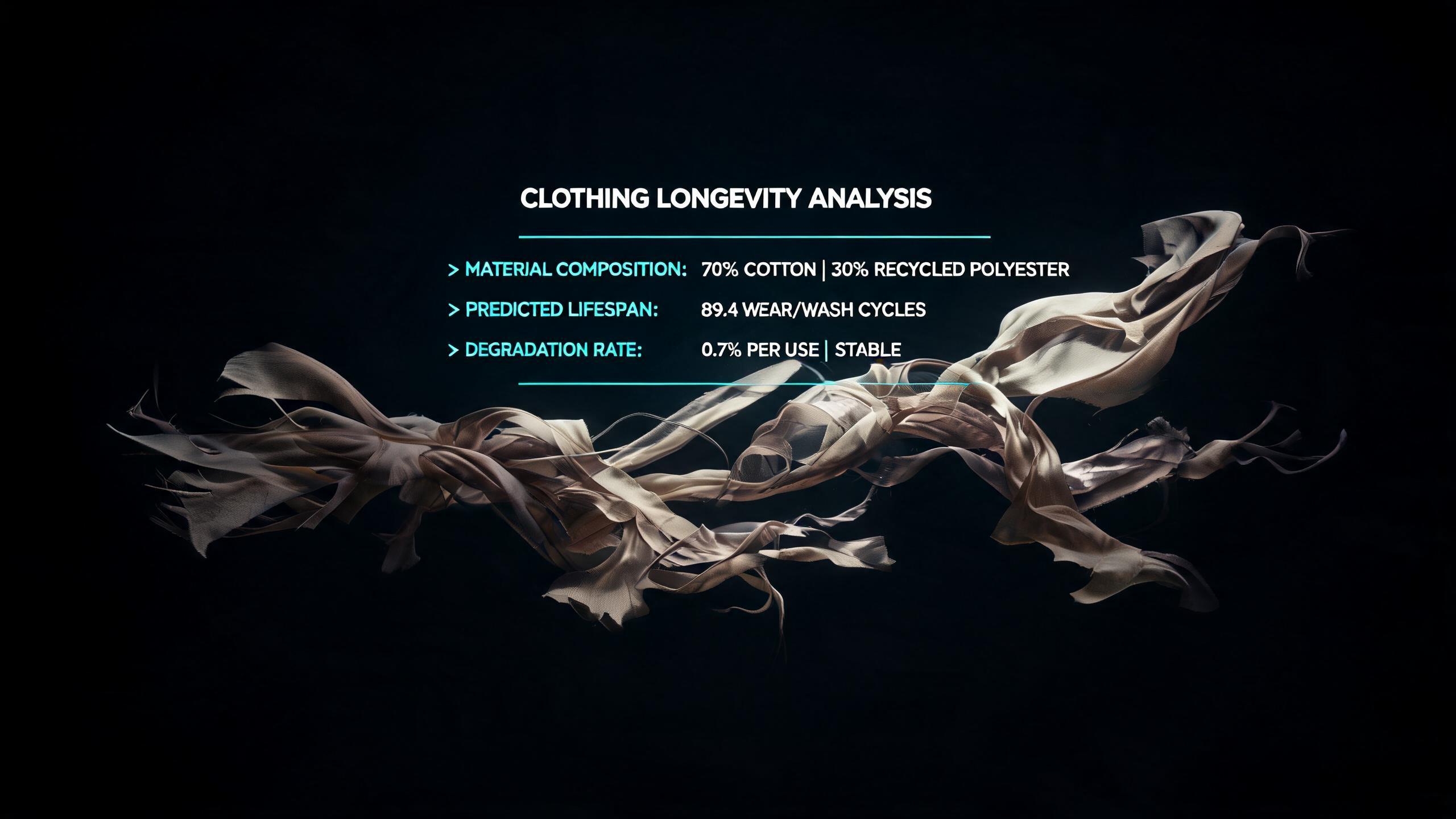
How Demna AI Identifies Clothing Fabric Composition

Learn how Demna AI analyzes visual texture, weave patterns, and garment details to estimate cotton, wool, silk, and synthetic fiber content.
Demna AI identifies clothing fabric composition by analyzing garment images to recognize visual and structural cues associated with fibers, weaves, knits, and blends. Its image-based output is an estimate rather than a certified laboratory result, so definitive composition requires physical fiber testing or the garment’s manufacturer label.
[[How Demna](https://blog.alvinsclub.ai/how-demna-ai-removes-backgrounds-from-clothing-photos)](https://blog.alvinsclub.ai/how-demna-ai-connects-your-favorite-clothing-retailer-accounts) AI Identifies Clothing Fabric Composition
Key Takeaway: Demna AI identifies clothing fabric composition by reading garment labels, analyzing fabric images, extracting product data, and classifying likely materials with confidence scoring.
Demna AI identifies clothing fabric composition by combining garment-label recognition, image analysis, product-data extraction, and confidence-based material classification.
Fabric composition matters because fiber content changes how a garment feels, fits, drapes, stretches, ages, washes, and performs across seasons. A jacket labeled “wool blend,” a shirt described as “technical jersey,” and trousers marketed as “structured cotton” communicate very different things unless their underlying materials are identified precisely.
Demna AI turns scattered clothing information into a usable material record. It can read a photographed care label, extract composition from a product page, compare conflicting descriptions, and organize the result inside a personal wardrobe model. The purpose is not to assign a fashionable label to a fabric.
The purpose is to understand what the garment is made of and how that construction should influence styling, care, fit, and future recommendations.
Clothing fabric composition identification: The process of determining which fibers and materials make up a garment, in what proportions, and with what construction details, using garment labels, product data, visual evidence, and confidence scoring.
This guide explains how Demna AI identifies fabric composition, how to prepare accurate inputs, how to verify uncertain results, and how to use material intelligence when building outfits or evaluating new clothing.
Why Does Clothing Fabric Composition Matter?
Fabric composition is a functional description of a garment. It affects the garment’s behavior more reliably than marketing language such as “premium,” “luxury,” “performance,” or “everyday essential.”
A fiber’s properties influence several practical decisions:
- Drape: whether the garment falls close to the body or holds a defined shape.
- Stretch: whether movement comes from elastane, knit construction, mechanical weave, or garment cut.
- Heat retention: whether the fabric insulates, ventilates, or traps moisture.
- Moisture management: whether the garment absorbs perspiration, dries quickly, or retains dampness.
- Abrasion resistance: how well the surface handles friction from bags, chairs, cuffs, and repeated wear.
- Care requirements: whether the garment tolerates machine washing, dry cleaning, steaming, or air drying.
- Surface behavior: whether it pills, creases, shines, felts, fades, or develops softness.
- Fit stability: whether it stretches out, relaxes, shrinks, or recovers after washing.
A product title rarely contains enough information to answer these questions. “Oversized wool coat” does not tell you whether the shell is pure wool, a wool-polyamide blend, or a synthetic coating with a small amount of wool. The composition label does.
Composition Is More Useful Than Fabric Names Alone
A fabric name describes a material category, but composition describes the actual fiber structure. “Satin” refers primarily to a weave or surface effect. It may be made from silk, polyester, acetate, viscose, or a blend.
Likewise:
- Jersey describes a knit structure, not a single fiber.
- Denim describes a woven cotton-based fabric category, but stretch denim may contain elastane or synthetic fibers.
- Fleece often describes a brushed surface or knit product rather than one specific fiber.
- Twill describes a weave pattern that can be produced from cotton, wool, polyester, or blended yarns.
- Leather describes animal hide, while coated fabrics may imitate its appearance without sharing its composition.
Demna AI separates material identity from fabric construction. That distinction prevents the system from treating every product descriptor as a fiber claim.
How Does Demna AI Identify Clothing Fabric Composition?
Demna AI uses a layered process instead of relying on one clue. The system first locates the strongest available evidence, then uses visual and contextual signals to fill gaps, and finally records uncertainty rather than presenting an unsupported guess as fact.
The main evidence sources are:
- Fiber-content labels
- Care labels and product tags
- Retailer product pages
- Brand technical descriptions
- Garment photographs
- Textile vocabulary and construction signals
- User corrections and wardrobe history
A label stating “70% wool, 20% polyamide, 10% cashmere” is stronger evidence than a product title saying “luxury wool coat.” A high-resolution image showing a ribbed knit can help identify construction, but it cannot reliably determine whether the yarn is wool, acrylic, cotton, or a blend without supporting evidence.
What Does Demna AI Extract From a Clothing Label?
When a user uploads a label image, Demna AI attempts to identify and normalize:
- Fiber names
- Fiber percentages
- Shell composition
- Lining composition
- Filling or insulation composition
- Trim composition
- Coating information
- Country-specific terminology
- Care instructions
- Recycled or regenerated material claims
- Leather, fur, down, or synthetic alternatives
- Unknown or illegible sections
The system should preserve the original text alongside the normalized interpretation. This matters because normalization can simplify terminology, but the original label remains the reference record.
For example:
| Original label text | Normalized interpretation |
|---|---|
| 100% CO | 100% cotton |
| 55% VI, 45% PES | 55% viscose, 45% polyester |
| 98% cotton, 2% elastane | Cotton woven fabric with stretch fiber |
| Outer: 100% wool; Lining: 100% cupro | Wool shell with cupro lining |
| Recycled PA | Recycled polyamide, percentage requires confirmation |
Abbreviations vary by region and manufacturer. Demna AI maps common abbreviations into a consistent vocabulary while retaining the source text for review.
How Can You Prepare the Best Input for Demna AI?
Accurate identification begins with accurate evidence. A blurred label, cropped composition panel, or product photograph without context limits what any visual system can determine.
1. Photograph the Fiber-Content Label
Place the garment on a flat surface and photograph the composition label directly. Use even lighting and hold the camera parallel to the label so the text does not become distorted.
Capture:
- The complete label
- Every percentage
- The distinction between shell, lining, filling, and trim
- Any symbol or abbreviation near the composition
- The reverse side if the label continues
- Multiple labels if the garment has separate material panels
Do not photograph only the brand name or size tag. Those details help identify the product, but they do not establish fabric composition.
2. Photograph Care and Construction Labels
Care labels may contain information missing from a marketing page. A padded coat, for example, may list shell, lining, and filling separately. A garment with a polyurethane coating may identify the coating on a secondary label.
Photograph labels in sequence so Demna AI can associate them with the correct garment. If you are documenting multiple items, place one garment in each image set and avoid mixing labels from similar pieces.
3. Add the Product Page When Available
A product page can supplement a difficult label. Submit the product link or copy the relevant material description when the page provides:
- Fabric composition
- Product reference code
- Season or collection
- Garment category
- Construction details
- Lining and filling information
- Finish or coating
- Recycled content statement
Product pages are useful but not automatically authoritative. Retail descriptions can simplify composition, omit secondary materials, or use commercial fabric names. Demna AI should compare product-page language with the label rather than replacing the label with marketing copy.
4. Include a Clear Garment Photograph
A front-facing image helps classify the garment and connect material information to its visual behavior. Include a second image showing the texture or underside when the surface is important.
Useful visual details include:
- Rib direction
- Knit gauge
- Twill lines
- Pile height
- Sheen
- Transparency
- Surface brushing
- Quilting
- Coating
- Seam construction
- Stretch recovery
- Wrinkling
Visual evidence supports construction analysis. It does not independently prove fiber percentages.
5. Add Context When the Label Is Incomplete
If the label is missing, tell Demna AI what you know:
- Brand
- Product name
- Approximate purchase date
- Retailer
- Product page
- Garment category
- Whether the fabric stretches
- Whether it feels crisp, soft, dense, fuzzy, cool, or slippery
- Whether it wrinkles quickly
- How it behaves after washing
These observations can improve classification, but they should remain secondary evidence. A soft, shiny shirt may be viscose, silk, acetate, polyester, or a blend. Sensory descriptions narrow possibilities without proving composition.
What Are the Main Steps for Using Demna AI to Identify Fabric Composition?
The following sequence creates a reliable material record and keeps uncertain information visible.
Select the Garment — Choose one clothing item and gather its label, product page, and clear photographs before starting the analysis.
Capture the Composition Label — Photograph the complete fiber-content label in sharp, even lighting, including shell, lining, trim, and filling information.
Add Product Evidence — Provide the product URL, product name, or retailer description when available so Demna AI can compare label language with catalog data.
Classify the Garment Structure — Let Demna AI identify whether the item is woven, knitted, felted, quilted, coated, brushed, laminated, or layered.
Normalize Fiber Names — Convert abbreviations and regional terminology into consistent fiber categories while preserving the original label wording.
Separate Material Layers — Record the shell, lining, insulation, trim, membrane, and coating as separate components instead of treating the garment as one fabric.
Assign Confidence Levels — Review whether each material claim is confirmed, inferred, or unresolved based on the quality of available evidence.
Verify Ambiguous Results — Compare the output with the physical label, official product page, or brand customer-service documentation when the composition affects purchase, care, allergies, or durability decisions.
Save the Material Profile — Store the composition with the garment’s fit, color, purchase history, care instructions, and styling behavior.
Use the Result in Outfit Decisions — Apply the material profile to layering, seasonal styling, care planning, and future recommendations.
Each step solves a different problem. Skipping label capture creates uncertainty. Skipping layer separation hides the difference between a wool shell and a polyester lining.
Skipping confidence scoring turns an inference into false precision.
How Does Demna AI Separate Shell, Lining, Filling, and Trim?
A garment is rarely made from one material. A technical jacket, for example, may include a nylon shell, polyester lining, synthetic insulation, elastane cuffs, and a polyurethane membrane.
Demna AI should represent these components separately:
| Garment component | What it describes | Why it matters |
|---|---|---|
| Shell | The main exterior material | Determines visible texture, weather response, and primary drape |
| Lining | Interior layer against the body or under the shell | Affects comfort, friction, breathability, and layering |
| Filling | Insulation or padding | Influences warmth, weight, loft, and care |
| Trim | Secondary elements such as cuffs, collars, or binding | Can alter stretch, durability, and visual contrast |
| Coating | Applied surface layer | Changes water resistance, sheen, hand feel, and aging |
| Membrane | Functional layer between textiles | Influences wind and moisture protection |
| Interlining | Hidden stabilizing layer | Affects structure, shape retention, and tailoring behavior |
This distinction helps explain why two garments with the same shell fiber can behave differently. A lightweight polyester shell with a soft knit lining is not equivalent to a laminated polyester shell with a stiff membrane.
Why Does Layer Separation Improve Styling?
Material layers influence how a garment interacts with other clothing. A coat with a slippery lining can accommodate a chunky knit more easily than an unlined wool coat. A padded jacket needs different proportion planning than an uninsulated overshirt, even when both have similar outer fabric.
For outfit recommendations, Demna AI can use these distinctions to avoid practical errors:
- Pairing a bulky sweater under a narrow, unlined jacket
- Recommending a delicate silk shirt beneath abrasive outerwear
- Treating a coated rain shell like a breathable cotton overshirt
- Suggesting heavy knit layers under a fitted garment with limited ease
- Ignoring static or friction between synthetic layers
Material identification becomes useful when it connects composition to behavior.
How Does Demna AI Interpret Common Fiber Categories?
Demna AI should treat fiber categories as behavior profiles, not simplistic quality rankings. Natural, regenerated, and synthetic fibers each include many constructions and finishes.
Natural Fibers
Common natural fibers include:
- Cotton
- Linen
- Hemp
- Wool
- Cashmere
- Alpaca
- Silk
- Mohair
- Down
- Leather
Natural fibers are not automatically breathable, durable, ethical, or easy to care for. A tightly woven cotton canvas behaves differently from a lightweight cotton voile. A dense wool coating behaves differently from a fine merino jersey.
Regenerated and Cellulosic Fibers
These include:
- Viscose
- Rayon
- Modal
- Lyocell
- Tencel
- Cupro
- Acetate
These terms need careful handling. “Viscose” and “rayon” commonly describe related regenerated cellulose categories, while modal and lyocell refer to specific forms of regenerated cellulose production. Acetate has different behavior from viscose despite appearing in similar drapey garments.
Demna AI should preserve the exact fiber name rather than collapsing every regenerated fiber into “rayon-like.”
Synthetic Fibers
Common synthetic fibers include:
- Polyester
- Polyamide or nylon
- Acrylic
- Elastane or spandex
- Polyurethane
- Polypropylene
- Polyethylene
Synthetic fibers can provide stretch, abrasion resistance, quick drying, insulation, shape retention, or surface effects. Their performance depends on yarn, knit or weave, finishing, density, and garment construction.
Animal-Derived Materials
Leather, suede, shearling, wool, silk, down, and feathers require separate material treatment. “Leather” should not be recorded as equivalent to “polyurethane leather.” “Down” should not be merged with “polyester fill.” These distinctions affect care, warmth, durability, and product interpretation.
How Can You Read a Fabric Composition Result?
A useful result includes four layers:
- Confirmed composition
- Material construction
- Functional interpretation
- Confidence and unresolved fields
For example:
Composition: Shell 70% wool, 20% polyamide, 10% cashmere. Lining 100% cupro. Construction: Dense woven coating with a smooth lining. Likely behavior: Warm, structured, moderately abrasion-resistant, prone to surface brushing and pressure creasing. Confidence: High for fiber percentages; medium for performance predictions.
The percentages come from the label. The behavior is an interpretation based on composition and construction. These should not be presented as the same type of fact.
Confirmed, Inferred, and Unknown Fields
| Status | Meaning | Example |
|---|---|---|
| Confirmed | Directly supported by a readable label or authoritative product record | “100% linen” from the composition label |
| Corroborated | Supported by more than one consistent source | Label and official product page match |
| Inferred | Suggested by visual or tactile evidence but not verified | “Likely brushed wool” from appearance |
| Unknown | No reliable evidence available | Exact elastane percentage absent |
| Conflicting | Sources disagree | Product page says wool blend; label lists polyester and viscose |
Confidence scoring is essential because clothing databases often contain incomplete or inconsistent information. A system that states “100% wool” from a product image alone creates false certainty.
👗 Retailers plug Alvin's Club in and see personalization land in weeks, not quarters. See how →
What Practical Material Clues Can Improve Identification?
Visual and physical clues help Demna AI interpret construction, but they should never override a readable composition label.
Texture and Surface
- Visible twill lines: suggest a twill weave, common in denim, chinos, suiting, and wool coatings.
- Vertical ribs: indicate rib knit or cord-like construction.
- Fuzzy halo: may indicate brushed wool, mohair, alpaca, fleece, or synthetic pile.
- Smooth sheen: may come from silk, acetate, polyester, viscose, satin weave, or finishing.
- Crinkled surface: may result from linen, seersucker, pleating, chemical finishing, or mechanical treatment.
- Compact matte surface: may indicate dense wool, cotton twill, technical synthetics, or brushed blends.
Behavior During Wear
Record observations such as:
- Does the garment recover after stretching?
- Does it crease at the elbow or knee?
- Does it cling to the body?
- Does it retain odor or dry quickly?
- Does the surface pill under a shoulder bag?
- Does it soften or become glossy with use?
- Does the color fade unevenly?
- Does the fabric become limp after washing?
These observations can enrich a personal material model. They should be stored as observed behavior, not misrepresented as laboratory composition.
How Do You Apply Fabric Composition to Outfit Planning?
Material identification becomes meaningful when it improves outfit logic. Composition helps determine how pieces should be layered, balanced, and maintained.
Outfit Formula: Structured Wool Trousers
- Top: Fine-gauge merino or smooth cotton knit with minimal surface bulk
- Bottom: Wool-blend trousers with a medium or high rise and a straight leg
- Shoes: Leather derby, refined sneaker, or low-profile loafer
- Accessories: Smooth leather belt, compact shoulder bag, and low-sheen metal watch
This formula works because the trousers provide structure while the top controls visual and physical bulk. If the trousers are wide with a hem width of approximately 18 to 22 inches around the full opening, a narrow shoe can appear visually underscaled; a moderate-volume shoe creates better balance.
Outfit Formula: Fluid Cellulosic Shirt
- Top: Viscose, lyocell, or cupro shirt with a relaxed shoulder and soft drape
- Bottom: High-rise straight-leg denim or compact cotton twill
- Shoes: Minimal leather sneaker, sandal, or almond-toe flat
- Accessories: Structured bag and one rigid accessory to contrast the fluid fabric
A fluid top benefits from a firmer bottom. If the shirt is oversized, a high rise can restore proportion without requiring a tight silhouette.
Outfit Formula: Technical Shell Layer
- Top: Fine merino base layer or close-fitting cotton jersey
- Bottom: Straight or tapered technical trouser with controlled volume
- Shoes: Low-profile trail sneaker, clean trainer, or weather-resistant boot
- Accessories: Lightweight crossbody bag and compact cap
The technical shell should be evaluated by membrane, lining, and coating information rather than by the word “performance.” A lined shell can add enough bulk to require a lower-profile mid-layer.
How Do Body Proportions Affect Material and Fit Decisions?
Material composition does not replace body measurements, but it helps determine how volume behaves around those measurements.
Useful comparisons include:
- If hips are 2 or more inches wider than shoulders, a fluid or softly structured top with a clean shoulder line can balance the silhouette without adding excessive volume at the hip.
- If shoulders are 2 or more inches wider than hips, trousers with a wider leg or a structured lower half can create visual equilibrium.
- If the torso is shorter relative to the legs, a high-rise trouser with a rise of roughly 10 to 12 inches can emphasize the waist position, while a cropped, low-bulk top prevents the upper body from appearing compressed.
- If the torso is longer relative to the legs, a mid-rise trouser and a slightly longer top can create a more continuous vertical line.
- If the garment is worn close to the body, stretch fiber and recovery matter more than the fiber category alone.
These are styling guidelines, not fixed rules. Demna AI should learn from the wearer’s actual outfit feedback instead of applying body-shape labels as permanent prescriptions.
Concrete Garment Specifications to Record
A useful wardrobe record can include:
- Rise: low, mid, or high; record the actual front rise when available.
- Inseam: record the length in inches or centimeters.
- Hem width: record the full leg opening, not only the flat measurement.
- Shoulder width: note whether the shoulder is natural, dropped, or extended.
- Chest ease: distinguish body measurement from garment measurement.
- Sleeve length: especially important for layered jackets.
- Fabric weight: light, medium, or heavy when exact weight is unavailable.
- Stretch recovery: poor, moderate, or strong.
- Opacity: transparent, semi-opaque, or opaque.
- Lining: fully lined, partially lined, or unlined.
For example, a pair of trousers with a 10.5-inch front rise, 30-inch inseam, and 15-inch full hem width creates a different styling system from trousers with the same waist measurement but a 12-inch rise and 20-inch hem width.
What Is the Difference Between Fiber Composition and Fabric Construction?
Fiber composition answers what the material is made from. Fabric construction answers how those fibers are assembled.
| Question | Composition answers | Construction answers |
|---|---|---|
| What is it made from? | Cotton, wool, polyester, silk, and blends | Not primarily |
| How is it assembled? | Not primarily | Knit, weave, felt, quilt, laminate |
| Why does it stretch? | Elastane may contribute | Knit structure may contribute |
| Why does it drape? | Fiber softness and density contribute | Weave, knit, and finishing contribute |
| Why does it resist rain? | Synthetic fibers may help | Coating, membrane, and seam treatment matter |
| Why does it pill? | Fiber length and blend matter | Surface friction and knit density matter |
This distinction prevents a common error: assuming fiber alone determines performance. Two garments with 100% polyester composition can feel completely different because one is a lightweight plain weave and the other is a dense brushed knit.
What Common Mistakes Should You Avoid?
Mistake 1: Treating the Product Title as the Composition
A title such as “linen shirt” may describe the dominant material, but it may not reveal a linen-viscose blend, elastane content, or polyester reinforcement.
Correction: Use the fiber-content label as the primary source and record the product title separately.
Mistake 2: Confusing Fabric Names With Fibers
“Satin,” “jersey,” “denim,” and “fleece” are not always fiber names.
Correction: Record both fields:
- Fiber composition: for example, 96% cotton, 4% elastane
- Construction: for example, stretch denim with twill weave
Mistake 3: Ignoring Lining and Filling
A coat may have a wool shell but a synthetic lining and polyester insulation. Recording only “wool coat” hides important behavior.
Correction: Separate shell, lining, filling, trim, coating, and membrane.
Mistake 4: Guessing Composition From Appearance
A shiny shirt is not necessarily silk. A soft sweater is not necessarily cashmere. A leather-like jacket may be polyurethane-coated textile.
Correction: Mark visual classifications as inferred until supported by a label or authoritative source.
Mistake 5: Treating “Recycled” as a Fiber Category
“Recycled polyester” is still polyester in the fiber taxonomy. “Recycled polyamide” remains polyamide.
Correction: Store recycled status as a separate attribute from the base fiber.
Mistake 6: Assuming a Blend Has Uniform Performance
A small amount of elastane can substantially change stretch. A small amount of nylon can alter abrasion resistance. A small amount of cashmere can change hand feel without making the garment behave like pure cashmere.
Correction: Track both percentages and garment construction.
Mistake 7: Losing the Original Label Text
A normalized database entry can be useful, but deleting the source wording makes later verification difficult.
Correction: Store an image or transcription of the original label beside the normalized record.
Mistake 8: Confusing Garment Measurement With Body Measurement
A 40-inch garment chest is not a 40-inch body chest. A 15-inch flat hem measurement is not the same as a 15-inch circumference.
Correction: Label every measurement as body, garment-flat, or garment-circumference data.
Mistake 9: Treating Care Instructions as Proof of Fiber
A “dry clean only” instruction does not prove wool, silk, or any other specific fiber. Finishes, construction, dyes, and trims can also determine care requirements.
Correction: Use care instructions to understand maintenance, not to infer composition.
Mistake 10: Allowing Conflicting Data to Disappear
Retailer pages, brand pages, resale listings, and labels can disagree.
Correction: Preserve the conflict, rank the evidence, and request verification when the difference affects a purchase or care decision.
How Can You Verify an Uncertain Fabric Result?
Verification should be proportional to the decision. If you are organizing a casual T-shirt, a low-confidence material note may be acceptable. If you have an allergy, are evaluating a high-value garment, or need a specific performance property, verify the composition before relying on it.
Use this sequence:
- Recheck the label image — Confirm that the percentage line is readable and not cropped.
- Compare official sources — Check the brand’s product page and garment reference code.
- Inspect secondary labels — Look for lining, filling, coating, or trim information.
- Contact the brand — Ask for the full composition when published details are incomplete.
- Separate facts from observations — Keep “label says” distinct from “feels like.”
- Lower confidence when sources conflict — Do not average contradictory claims into a false middle answer.
- Update the wardrobe record — Replace inferred data with verified data when new evidence arrives.
A consumer-facing AI system should never imply laboratory certainty from a photograph. Fiber analysis can require specialized testing when labels are absent or disputed.
How Does Material Data Improve a Personal Style Model?
A personal style model should learn more than color and silhouette. It should learn which materials the wearer consistently chooses, tolerates, avoids, and reuses.
Relevant material preferences include:
- Preference for crisp cotton over fluid viscose
- Avoidance of wool against bare skin
- Preference for low-maintenance synthetics during travel
- Attraction to dense fabrics with strong structure
- Dislike of clingy jersey
- Preference for natural-fiber layers
- Sensitivity to scratchiness, heat, static, or weight
- Tendency to wear smooth fabrics with tailored clothing
- Interest in recycled or animal-derived materials
- Willingness to accept complex care for specific silhouettes
This information produces better recommendations than a generic instruction such as “recommend minimalist outfits.” Two people can share the same visual style while having entirely different material constraints.
A dynamic style model should also learn from behavior:
- Which fabric-heavy outfits are worn repeatedly
- Which garments remain unworn despite visual appeal
- Which pieces receive positive fit feedback
- Which items are returned or altered
- Which compositions survive washing well
- Which layers create discomfort or bulk
- Which materials work across the wearer’s climate and schedule
Material intelligence turns clothing preference into a measurable, evolving signal.
How Can Demna AI Use Composition Data for Better Recommendations?
A recommendation system should use fabric composition as a constraint and a compatibility signal, not as a decorative product tag.
Better Seasonal Matching
A wool coating, linen shirt, and insulated synthetic jacket have different climate roles. Recommendations can prioritize material combinations that match expected temperature, humidity, and activity.
Better Layering
A low-bulk knit can fit beneath a tailored jacket. A high-loft sweater may require a larger outer layer. A slippery lining can change whether a textured knit layers smoothly.
Better Care Compatibility
If an outfit combines several delicate garments, the system can avoid treating it like a low-maintenance daily uniform. Care frequency and cleaning method influence whether a recommendation is realistic.
Better Durability Planning
A soft, loosely woven fabric may not be ideal beneath a rough shoulder strap. A high-friction synthetic may be a better travel layer. Material intelligence connects the outfit to actual use conditions.
Better Purchase Comparisons
Two similar garments can be compared by:
- Fiber composition
- Layer construction
- Stretch and recovery
- Care requirements
- Seasonal utility
- Compatibility with the existing wardrobe
- Expected duplication of current pieces
This is more useful than ranking products by popularity or visual similarity alone.
How Does Fabric Identification Connect to Fit Analysis?
Fabric and fit are linked. A garment’s measurements describe its dimensions, while composition and construction help explain how those dimensions behave on the body.
A rigid cotton trouser with a 32-inch waist and 30-inch inseam will not wear like a stretch cotton trouser with the same measurements. A wool jacket with a structured canvas may maintain a sharp shoulder, while a soft unstructured jacket collapses closer to the body.
Demna AI can connect material and fit signals such as:
- Stretch percentage and actual ease
- Fabric weight and shoulder collapse
- Drape and perceived garment volume
- Recovery and knee or elbow bagging
- Surface friction and layering difficulty
- Lining and sleeve mobility
- Shrinkage risk and post-wash measurements
For a deeper fit workflow, see 7 Ways Demna AI Can Detect Clothing Fit Issues. Fit detection becomes more accurate when the system knows whether a tight area comes from insufficient garment ease, rigid fabric, poor stretch recovery, or a construction choice.
How Should You Store a Demna AI Material Record?
A useful material record should be structured, editable, and connected to the garment rather than buried in free-form notes.
Recommended fields include:
| Field | Example |
|---|---|
| Garment category | Overshirt |
| Brand and product | Brand name and product reference |
| Shell composition | 100% cotton |
| Lining composition | Unlined |
| Construction | Woven twill |
| Finish | Garment washed |
| Stretch | None |
| Weight | Medium |
| Drape | Moderate structure |
| Care | Machine wash cold; air dry |
| Confidence | High |
| Evidence | Label photograph and official product page |
| Observed behavior | Softens after wash; minimal wrinkling |
| Styling role | Transitional outer layer |
This structure allows AI recommendations to use material information without forcing the user to remember every detail.
The record should also support corrections. If a label is later found to differ from a retailer listing, the system should preserve the revision history and update recommendations based on the verified value.
What Should You Do When a Garment Has No Label?
Unlabeled garments are common in resale, vintage, altered, and handmade clothing. Demna AI can still create a provisional record, but it should label the result clearly.
Use a three-tier approach:
Tier One: Searchable Evidence
Look for:
- Brand archive pages
- Product reference numbers
- Retailer listings
- Resale descriptions with original tags
- Catalog photographs
- Care-label fragments
- Purchase receipts
Tier Two: Construction Analysis
Document:
- Woven or knit structure
- Surface texture
- Weight
- Stretch
- Transparency
- Drape
- Lining
- Coating
- Hardware
- Seam finish
Tier Three: Provisional Classification
Record a range or category only when exact composition cannot be established. For example:
- “Likely synthetic woven shell; exact fiber unknown”
- “Natural-fiber knit suspected; wool versus alpaca unresolved”
- “Leather-like coated textile; composition unverified”
A provisional classification is useful for styling, but it should not be used for allergy, safety, resale, or care claims without verification.
How Can You Use the Result for Clothing Care?
Composition data should guide care, but the garment’s care label remains the primary instruction. Fiber content alone does not account for dyes, coatings, interfacing, embellishments, and construction.
Use composition to anticipate:
- Shrinkage: common risk for some untreated natural fibers and unstable constructions.
- Felting: possible in animal-hair fibers under heat, agitation, and moisture.
- Pilling: influenced by fiber length, blend, friction, and surface structure.
- Color loss: influenced by dye type, fiber, washing, light, and abrasion.
- Shape change: influenced by knit structure, elastane recovery, and drying method.
- Coating damage: possible with heat, solvents, abrasion, or inappropriate cleaning.
- Static: common in dry conditions and some synthetic combinations.
Do not override the care label because an AI system predicts that a fiber “should” tolerate a certain treatment. The correct hierarchy is:
- Garment care label
- Brand care guidance
Professional cleaner for complex or high-value items 4. AI interpretation as supporting context
The guide to tracking clothing purchases with Demna AI is useful for connecting purchase records, care details, and observed garment performance over time.
What Does a High-Quality Demna AI Result Look Like?
A strong output is precise about facts and restrained about uncertainty.
Example: High-Confidence Result
Shell: 100% linen Lining: None Construction: Plain-weave woven fabric Observed behavior: Crisp hand, visible slub, moderate wrinkling Styling role: Warm-weather overshirt or standalone top layer Confidence: High for composition; medium for performance interpretation Verification: Readable garment label
Example: Mixed-Evidence Result
Shell: Product page describes a wool blend; label image is partially unreadable Likely composition: Wool with synthetic reinforcement, exact percentages unknown Construction: Dense woven coating Observed behavior: Structured drape, low visible stretch Confidence: Medium for fiber category; low for exact percentages Next action: Photograph the full label or verify with the brand
The second result is more trustworthy than a fabricated exact percentage. Precision without evidence is not intelligence.
Why Is Fabric Composition Part of AI-Native Fashion Intelligence?
Traditional fashion recommendation systems focus heavily on visual similarity, category, price, and popularity. Those signals help identify what resembles a garment, but they do not explain whether the recommendation will work in the wearer’s actual wardrobe.
Fabric composition adds a behavioral layer. It tells the system how a piece participates in an outfit:
- Whether it adds structure or softness
- Whether it creates warmth or ventilation
- Whether it layers easily
- Whether it requires delicate care
- Whether it repeats an existing material role
- Whether it solves a real wardrobe gap
- Whether the wearer tends to keep or abandon similar pieces
This is the difference between an AI feature and an AI infrastructure layer. A recommendation engine that merely recognizes “black jacket” has limited understanding. A personal style model that knows the wearer prefers unstructured wool, avoids shiny synthetics, needs low-maintenance travel layers, and dislikes bulky sleeves can make materially better decisions.
Fashion intelligence should be grounded in evidence, updated through use, and explicit about uncertainty.
Final Checklist: How to Identify Fabric Composition With Demna AI
Before saving a garment profile, confirm the following:
- Did you photograph the complete composition label?
- Did you separate shell, lining, filling, trim, coating, and membrane?
- Did you preserve the original label text?
- Did you distinguish fiber from fabric construction?
- Did you compare the label with official product data?
- Did you mark inferred details as inferred?
- Did you record unknown percentages instead of guessing?
- Did you capture garment measurements separately from body measurements?
- Did you note stretch, drape, weight, and surface behavior?
- Did you connect composition to care instructions?
- Did you save the result to the garment’s wardrobe record?
- Did you allow future corrections?
The process is simple when treated as structured evidence collection: capture, extract, separate, verify, and learn.
How Does Demna AI Identify Clothing Fabric Composition?
Demna AI identifies clothing fabric composition by combining readable labels, product data, image-based construction analysis, normalized fiber terminology, and confidence scoring. It separates shell, lining, filling, trim, coating, and membrane information so a garment becomes a complete material profile rather than a single vague fabric label.
AI-powered fashion intelligence, like AlvinsClub, uses that profile to build your personal style model. Every outfit recommendation learns from you. Try AlvinsClub →
Summary
- Demna AI identifies clothing fabric composition by combining garment-label recognition, image analysis, product-data extraction, and confidence-based material classification.
- The demna ai identify clothing fabric composition process determines a garment’s fibers, proportions, and construction details from labels, product pages, visual evidence, and confidence scoring.
- Fabric composition affects how clothing feels, fits, drapes, stretches, ages, washes, and performs across seasons.
- Demna AI can photographically read care labels, extract composition from product pages, compare conflicting descriptions, and organize material data in a personal wardrobe model.
- Accurate composition identification helps users make better styling, garment-care, fit, and future clothing-recommendation decisions.
Key Takeaways
- Key Takeaway:
- Demna AI
- Clothing fabric composition identification:
- Drape:
- Stretch:
Frequently Asked Questions
What is Demna AI used for in clothing analysis?
Demna AI is used to identify garment materials, interpret care labels, and organize product information from clothing images or listings. Its analysis can help shoppers and retailers understand whether an item contains cotton, wool, polyester, nylon, elastane, or blended fibers.
How does AI recognize fabric composition from a clothing label?
AI recognizes fabric composition by reading text on sewn-in labels, hangtags, packaging, or product images using optical character recognition. It then extracts fiber names and percentages, corrects unclear characters, and matches the results to standardized material categories.
Can AI identify fabric type from a clothing photo without a label?
AI can estimate fabric type from a clothing photo by analyzing visual features such as texture, weave, shine, stretch, thickness, and drape. Image-based predictions are less reliable than a readable fiber label because different materials can have similar appearances.
How accurate is AI fabric composition detection?
AI fabric composition detection is most accurate when the source image clearly shows a complete care label or verified product description. Accuracy may decrease when text is blurry, composition percentages are missing, or the garment uses visually similar blended fabrics.
Why does clothing fabric composition matter?
Clothing fabric composition affects comfort, breathability, durability, stretch, warmth, appearance, and washing requirements. Knowing the fiber content also helps shoppers compare garments, select suitable clothing for different conditions, and avoid materials that may cause irritation or require special care.
Can Demna AI detect blended fabrics and fiber percentages?
Demna AI [can detect](https://blog.alvinsclub.ai/7-ways-demna-ai-can-detect-clothing-fit-issues) blended fabrics when the label or product data lists multiple fibers and their percentages. It can classify combinations such as cotton-polyester, wool-nylon, or viscose-elastane, while unclear or incomplete information may produce a lower-confidence result.
Is AI fabric identification worth using when buying clothes online?
AI fabric identification is useful when online listings provide incomplete descriptions or when shoppers need a quick material comparison across products. It should be treated as a decision-support tool and checked against the manufacturer’s label, official product page, or care documentation when composition is important.
Related on Alvin's Club
About the author
Building the AI fashion agent at Alvin's Club — personal style models, dynamic taste profiles, and private AI stylists. Writing about where AI meets fashion commerce.
Credentials
- Founder at Alvin's Club (Echooo E-Commerce Canada Ltd.)
- Writes weekly on AI × fashion at blog.alvinsclub.ai
X / @alvinsclub · LinkedIn · alvinsclub.ai
This article is part of Alvin's Club's AI Fashion Intelligence series — the AI fashion agent that influences demand before shopping happens.
Related Articles
- 7 Ways Demna AI Can Detect Clothing Fit Issues
- The Style Guide to Tracking Clothing Purchases with Demna AI
- How Demna AI Connects Your Favorite Clothing Retailer Accounts
- Finding Demna-Inspired Pieces on AI-Powered Resale Platforms
- How Demna’s AI Track Is Rewriting Clothing Care in 2026
- Demna AI vs Traditional Search for Finding Similar Clothing
- Demna AI vs Traditional Methods for Fixing Clothing Recognition Errors
- Sustainable Clothing Recommendations: Human Stylists vs Demna AI
- Can Demna’s AI Handle Clothing Size Changes?
- Can AI Stylists Identify Clothing Brands? We Compare the Best Tools
- How Demna AI Removes Backgrounds from Clothing Photos
- Demna AI’s Image Deletions Reveal Fashion Tech’s Privacy Shift