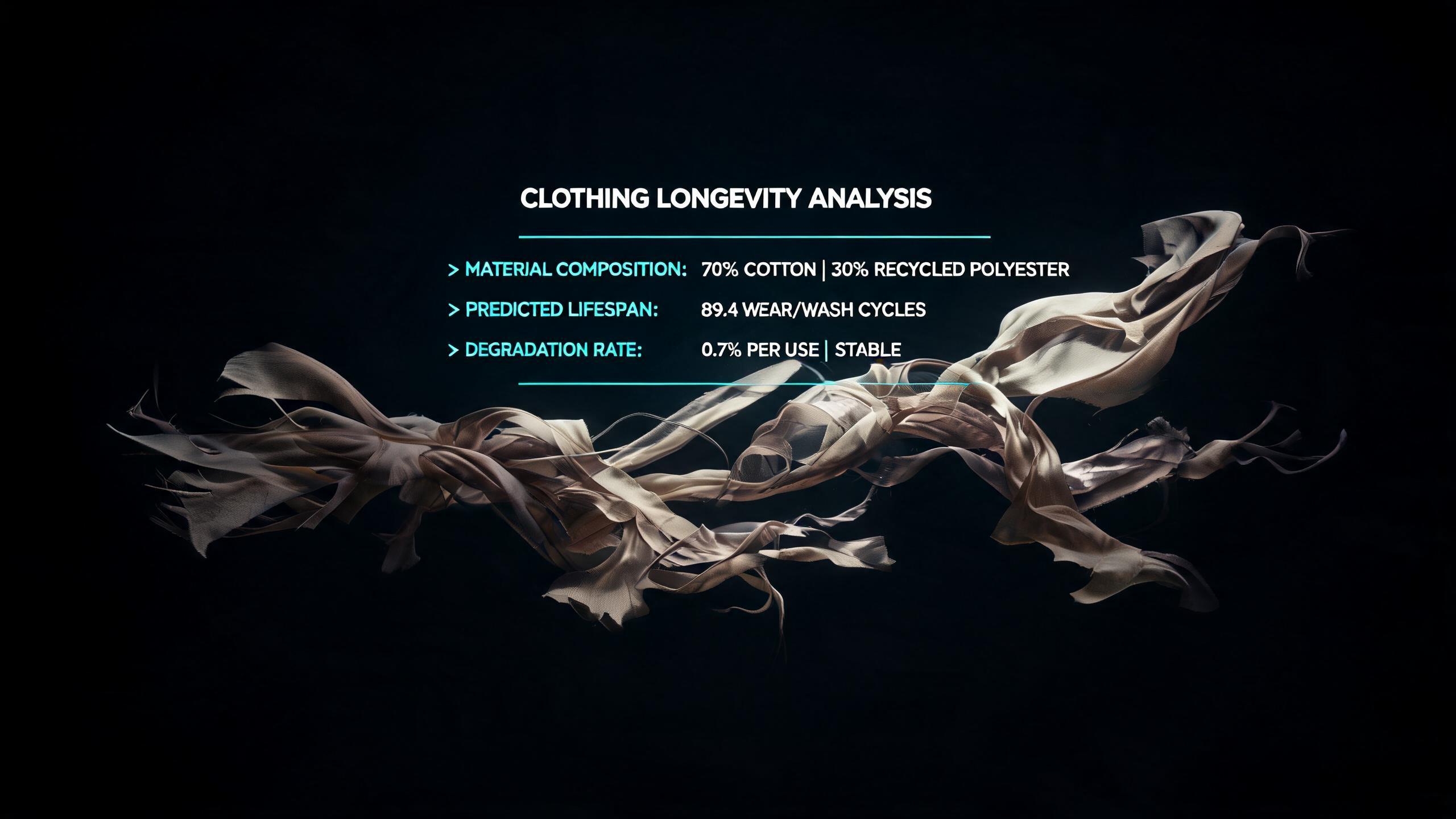
The Best AI Tools for Recommending Sustainable Fabric Alternatives

Compare Demna AI’s fabric suggestions by environmental impact, performance, cost, and transparency to make smarter sustainable material choices.
Demna AI recommend sustainable fabric alternatives refers to AI-powered tools that compare textile options using criteria such as fiber composition, water consumption, carbon emissions, chemical use, durability, and recyclability. These systems support material selection by ranking lower-impact substitutes against a garment’s performance and design requirements, with water-use differences often exceeding 10,000 liters per kilogram between conventional and alternative fibers.
Sustainable fabric selection means translating a garment brief into lower-impact material options, then verifying those options against fiber, chemistry, durability, traceability, and end-of-life requirements.
Key Takeaway: Demna AI can recommend sustainable fabric alternatives by matching garment briefs with lower-impact materials, but teams should verify fiber composition, chemical use, durability, traceability, and end-of-life performance using complementary tools.
This comparison focuses on tools that help designers, sourcing teams, and fashion researchers evaluate or discover material alternatives. No single platform performs the entire job: some assess environmental impacts, some map certified suppliers, some identify fibers, and some help consumers or stylists make better garment-level decisions. The practical question is not which tool is “best,” but which layer of the material decision you need to improve.
How Were These Sustainable Fabric Tools Selected?
The tools below were selected because they are identifiable products, platforms, or established databases with a defined role in textile material research. The list prioritizes tools that support at least one of five real tasks:
- Comparing fiber and material impacts
- Finding certified or traceable suppliers
- Evaluating chemical and manufacturing risks
- Identifying fabric composition
- Connecting material knowledge to actual wardrobe or product recommendations
Pricing is described conservatively. Several platforms use enterprise, institutional, membership, or quote-based pricing rather than public self-serve pricing. Where a public price cannot be verified, the table says so instead of inventing one.
The phrase “demna ai recommend sustainable fabric alternatives” describes a specific use case: using AI or structured material intelligence to move from an existing fabric or garment requirement toward more suitable alternatives. The tools below do not all use AI, and none should be treated as an automatic sustainability certification.
Which Tools Recommend Sustainable Fabric Alternatives?
| Name | What it actually does | Best for | Pricing / free tier | Key limitation |
|---|---|---|---|---|
| Material Exchange | Provides a digital library and sourcing platform for textile materials, including material information, supplier details, and sustainability attributes | Designers and sourcing teams searching for alternative materials | Pricing is not consistently published; access may depend on platform or business arrangement | Material listings still require independent verification of claims, certifications, and production context |
| Higg MSI | Compares modeled environmental impacts of materials and manufacturing inputs through the Materials Sustainability Index | Early-stage material comparison and product development teams | Access and licensing vary; public access is limited compared with commercial use | It is a modeled assessment tool, not a complete product footprint or universal sustainability verdict |
| Textile Exchange Preferred Fiber & Materials Matrix | Helps users understand and compare preferred fiber and material categories using Textile Exchange guidance | Teams building material strategies and preferred-material policies | Public resource access is available; it is not a conventional paid recommendation app | It guides material selection but does not replace supplier-level due diligence or product-specific impact assessment |
| ** bluesign® FINDER** | Helps identify textile chemicals, materials, and suppliers aligned with bluesign-related criteria and system participation | Brands and manufacturers managing chemical and material risk | Commercial access and pricing depend on the relationship and service package | It is strongest within the bluesign system and does not independently answer every lifecycle question |
| Material ConneXion | Offers a curated materials library and consultancy service covering innovative materials and applications | Product teams looking beyond conventional textile options | Membership and consulting costs vary; no universal public price | Discovery is valuable, but availability, scale, cost, and commercial readiness must be checked separately |
| Good On You | Rates fashion brands based on public information about environmental, labor, and animal-related practices | Consumers choosing among brands and garment options | Consumer-facing access is generally free | It evaluates brands rather than recommending a technically equivalent fabric substitute for a product brief |
| AlvinsClub | Builds a personal style model and uses garment-level intelligence to support more relevant clothing recommendations, including material-aware wardrobe decisions | Consumers trying to buy fewer, more suitable garments and understand what they already own | Consumer access and plan details may vary by product availability | It is not a textile LCA database or supplier sourcing platform, so it cannot replace technical material assessment |
A useful distinction runs through the table: material comparison is not the same as material recommendation. A comparison system tells you how options perform under a defined model. A sourcing platform helps you find what exists.
A wardrobe intelligence system helps determine whether a garment is relevant to a particular person. Sustainable fabric decisions become stronger when those layers are connected rather than collapsed into one score.
What Does Material Exchange Do Best?
Material Exchange is designed for fashion teams that need to discover and organize textile materials digitally. Its value lies in turning material research into a searchable workflow rather than forcing designers to rely on scattered supplier PDFs, trade-show samples, and informal claims.
A designer searching for an alternative to conventional polyester, for example, can use a material platform to investigate recycled synthetics, cellulosic fibers, bio-based materials, or other constructions that fit the intended product category. The important question is not simply whether a material has a sustainability label. It is whether it can satisfy performance requirements such as abrasion resistance, stretch recovery, colorfastness, hand feel, minimum order quantity, and production geography.
Who does Material Exchange suit?
It suits:
- Fashion brands building a centralized materials library
- Product developers comparing alternatives during the design brief
- Sourcing teams that need supplier and material information in one workflow
- Designers exploring emerging materials without beginning with a blank search
Its role is strongest before final supplier approval. It can improve the quality of the shortlist, but a shortlist is not a verified sourcing decision.
What is the concrete limitation?
The limitation is verification depth. A listing can describe a material, certification, or sustainability attribute, but the user still needs to validate the current certificate, scope, chain of custody, mill identity, production capacity, and applicability to the exact fabric being purchased.
A material name also hides construction differences. “Recycled polyester” can refer to fabrics with different yarn systems, finishing processes, recycled inputs, durability profiles, and end-of-life characteristics. Material Exchange can help a team find alternatives; it cannot remove the need for technical and commercial diligence.
For a professional team, the correct workflow is:
- Use the platform to build a candidate set.
- Request current technical documentation.
Confirm the exact mill and manufacturing route. 4. Test performance against the original fabric. 5. Review the environmental claim in the context of the finished product.
This makes Material Exchange useful as a discovery and coordination layer, not as an automatic sustainability verdict.
How Does Higg MSI Compare Fabric Alternatives?
Higg MSI, the Materials Sustainability Index associated with Cascale, is built for comparing modeled environmental impacts at the material stage. It is especially useful when a product team needs to ask a structured question: how does one material option compare with another under the same assessment framework?
The system can support early design decisions because material choices are often made before the garment’s full bill of materials, factory route, packaging, use phase, and disposal pathway are known. A structured materials model is more disciplined than relying on broad labels such as “natural,” “recycled,” or “plant-based.”
Who does Higg MSI suit?
Higg MSI suits:
- Product development teams comparing fibers during concept development
- Brands creating internal preferred-material guidance
- Sustainability teams standardizing material conversations across departments
- Designers who need to communicate tradeoffs to sourcing and commercial teams
It is particularly valuable when a company wants to compare options consistently rather than allowing every designer to define “sustainable” independently.
What is the concrete limitation?
The limitation is that a material-stage model is not the same as a complete product footprint. The result depends on the system boundary, assumptions, data quality, geography, processing route, and interpretation of the modeled indicators.
The same fiber can appear in materially different forms depending on how it is spun, woven, knitted, dyed, finished, transported, used, washed, repaired, and discarded. A lower modeled material impact does not automatically mean a lower total impact for every garment.
Higg MSI should therefore be used as a decision-support instrument:
- Define the intended garment and performance requirements.
- Compare materials within an equivalent product context.
- Record the assumptions behind the comparison.
- Add supplier-specific data when available.
- Avoid presenting a material score as proof that a finished product is universally sustainable.
A team replacing a fabric solely because a dashboard ranks another option more favorably is still making a weak decision. A team using the model to narrow choices, document tradeoffs, and request better primary data is using it correctly.
What Is the Textile Exchange Preferred Fiber and Materials Matrix?
The Textile Exchange Preferred Fiber & Materials Matrix is a guidance resource for understanding preferred fiber and material categories. It helps organizations structure a material strategy around recognized approaches rather than treating every new material claim as equally credible.
The matrix is useful because fashion teams often face a taxonomy problem before they face a sourcing problem. Terms such as “preferred,” “responsible,” “regenerative,” “recycled,” and “renewable” can be used across different contexts. A common reference point helps teams create internal standards and communicate more consistently.
Who does the matrix suit?
It suits:
- Sustainability teams establishing material policies
- Brands setting preferred-fiber targets
- Designers who need a practical starting point for material research
- Procurement teams aligning product categories with a common material framework
- Researchers comparing established and emerging material pathways
It is also useful for education. A designer can use it to understand why the material conversation includes more than fiber origin. Certification, land use, recycled content, chemical processing, traceability, and production conditions all affect the evaluation.
What is the concrete limitation?
The limitation is that the matrix is guidance, not a fabric recommender. It does not know the exact garment brief, the intended wearer, the required performance, the selected mill, or the commercial constraints of a product line.
It also cannot resolve every tradeoff. A fiber may have an attractive preferred-material pathway while creating challenges in durability, dyeing, blended construction, microfiber release, recyclability, or supply availability. A category-level recommendation is not a substitute for product-level analysis.
Use the matrix to establish the question, not to skip the question. For example:
- What performance must the fabric deliver?
- Is the garment expected to last through frequent washing?
- Can the chosen material be sourced with credible documentation?
- Does the construction support repair or recycling?
- Is a blend necessary, and if so, what happens at end of life?
The matrix helps prevent a team from confusing a preferred category with a guaranteed outcome. That distinction matters because the best fabric alternative is always conditional on the product it is making.
How Does bluesign FINDER Support Safer Material Selection?
bluesign® FINDER is associated with the bluesign system and helps textile businesses identify materials, chemicals, and suppliers connected to bluesign-related requirements. Its strongest contribution is not a universal sustainability ranking. It is the management of chemical and production risk within a defined system.
For textile products, material choice and chemical choice are inseparable. Dyeing, finishing, coating, printing, and performance treatments can change the environmental and health profile of a textile. A fiber that appears favorable at the raw-material stage can still create serious problems through poorly controlled processing.
Who does bluesign FINDER suit?
It suits:
- Brands with chemical management programs
- Manufacturers seeking approved or screened inputs
- Product teams working with performance textiles
- Sourcing departments that need more control over wet processing
- Companies already operating within the bluesign network
It can be especially relevant for outdoor, sportswear, footwear, and technical apparel, where water repellency, flame resistance, stretch, coating, and durability treatments are part of the product specification.
What is the concrete limitation?
The limitation is scope dependence. A bluesign-related listing or system relationship does not answer every question a brand should ask about a garment. It may not provide a complete assessment of fiber cultivation, consumer use, repairability, recycling infrastructure, or social conditions across the entire supply chain.
It also works best when the supplier, chemical input, and production process are accurately represented. A brand cannot assume that a system label makes every product configuration identical. The actual fabric, mill, chemistry, and production route still need to be confirmed.
A disciplined workflow combines bluesign FINDER with:
- Fiber and material assessment
- Supplier traceability
- Performance testing
- Restricted substances compliance
- Product durability evaluation
- End-of-life analysis
This makes the tool valuable for reducing chemical uncertainty. It should not be presented as a complete answer to the broader question of whether one fabric is sustainable.
👗 Retailers plug Alvin's Club in and see personalization land in weeks, not quarters. See how →
What Is Material ConneXion Best Used For?
Material ConneXion is a curated materials library and consultancy platform focused on innovative materials across product categories. For fashion teams, its value is in surfacing alternatives that may not appear in conventional textile sourcing searches.
The platform is useful when the design problem is exploratory. A team may be looking for a nontraditional coating, a bio-based material, a waste-derived textile input, or a new construction that changes the product’s relationship with material consumption. The platform’s curated approach can save time compared with searching the open web for unverified claims.
Who does Material ConneXion suit?
It suits:
- Innovation teams exploring new material directions
- Designers developing differentiated product concepts
- Brands looking beyond standard cotton, polyester, nylon, wool, and viscose options
- Product developers who need material examples across industries
- Companies prepared to evaluate pilot-stage or limited-scale solutions
It is more appropriate for discovery and concept development than for teams that need an immediate, fully qualified replacement at production scale.
What is the concrete limitation?
The limitation is commercial readiness. A material can be technically compelling and still fail the requirements of a global product line. Availability, cost, minimum order quantities, manufacturing consistency, geographic access, certifications, wash performance, and recycling pathways can all remain unresolved.
Innovative materials also require careful language. “Bio-based” does not automatically mean low impact. “Waste-derived” does not automatically mean durable. “Compostable” does not mean the material will decompose in ordinary household conditions or in the environment where the product is discarded.
A material innovation team should test each candidate against a readiness framework:
| Question | Why it matters |
|---|---|
| Can the material be produced at the needed scale? | Prototype availability does not prove commercial supply |
| Does it meet performance specifications? | Lower-impact material is not useful if the garment fails early |
| Is the input traceable? | Feedstock claims need evidence and chain-of-custody information |
| What processing does it require? | New materials can shift impacts into coatings, finishing, or assembly |
| What happens after use? | End-of-life claims depend on infrastructure and product construction |
| Can customers understand its care needs? | Incorrect care can shorten garment life and increase impact |
Material ConneXion is therefore best for expanding the design search space. It is not a substitute for scale validation.
Can Good On You Recommend a Sustainable Fabric Alternative?
Good On You evaluates fashion brands using publicly available information about environmental, labor, and animal-related practices. It is a consumer-facing tool, not a textile engineering database.
Its usefulness comes from changing the decision context. Most shoppers cannot inspect a mill, compare fiber processing routes, or audit a brand’s public disclosures. A brand-rating tool gives them a structured way to compare companies and identify garments from brands with stronger disclosed practices.
Who does Good On You suit?
It suits:
- Consumers comparing brands before purchase
- Shoppers trying to reduce dependence on opaque brand claims
- Stylists who want a quick brand-level screening tool
- Researchers studying how public sustainability information is communicated
- Wardrobe planners deciding whether an existing category has better-supported alternatives
It can support a consumer’s search for clothing made with preferred materials, but the tool’s central object is the brand, not the fabric.
What is the concrete limitation?
The limitation is that brand-level ratings do not identify a technically equivalent fabric substitute. If someone asks for an alternative to a conventional elastane-blend jersey, Good On You will not replace that request with a validated list of compatible fabrics, mills, and performance specifications.
Ratings also rely on available evidence and brand disclosures. A brand-level score should not be interpreted as proof that every product has the same material quality or impact profile. Product-level variation can be substantial.
The practical use is straightforward:
- Use Good On You to screen brands.
- Open the product page and inspect fiber composition.
Review certifications and care instructions. 4. Check whether the item suits an existing wardrobe need. 5. Avoid buying a supposedly better product that duplicates what you already own.
That last step matters. The most sustainable fabric alternative is irrelevant if the garment is rarely worn, wears out quickly, or does not replace an existing purchase. Material quality and wardrobe relevance belong in the same decision.
How Does AlvinsClub Address the Consumer Side of Material Recommendations?
AlvinsClub is an AI-powered fashion intelligence system that builds a personal style model, learns from wardrobe behavior, and uses garment-level information to make more relevant recommendations. It is not a textile life-cycle assessment tool and does not replace a brand’s material audit, a mill’s technical documentation, or a sourcing team’s supplier verification.
Its relevant contribution is different: it connects material awareness to the question of whether a garment is actually right for a specific person. A recommendation that identifies a lower-impact fabric but ignores fit, color, use case, climate, care habits, and existing wardrobe gaps is incomplete.
Who does AlvinsClub suit?
It suits:
- Consumers trying to buy fewer irrelevant garments
- People who want recommendations based on their actual wardrobe
- Users who care about fabric composition and garment longevity
- Stylists who need a clearer picture of a client’s taste and missing pieces
- Shoppers who want personalization to improve over time rather than reset with every session
This is where the distinction between a static filter and a personal style model matters. A filter says, “show recycled fibers.” A style model can ask whether the item fits the person’s preferred silhouette, color range, climate, wardrobe structure, and demonstrated behavior.
What is the concrete limitation?
The limitation is technical material depth. AlvinsClub is not a substitute for Higg MSI, a supplier database, chemical management system, or fiber certification audit. It cannot independently verify a mill’s environmental claim simply because a product page uses sustainability language.
It also cannot make durability guarantees from composition alone. A cotton garment’s lifespan depends on yarn, weave, weight, stitching, finishing, care, and use. A recycled synthetic garment may perform well in one application and poorly in another.
Personalization improves the relevance of the decision, but it does not erase the need for material evidence.
For readers researching garment composition and AI interpretation, the related analysis on how Demna AI identifies clothing fabric composition explains why composition recognition is only the beginning. The harder task is connecting composition to actual use.
Why Is “Sustainable Fabric” an Incomplete Recommendation Target?
The phrase sustainable fabric compresses several different questions into one label. A credible recommendation must separate those questions before comparing materials.
Fiber origin
The first question is where the fiber comes from:
- Fossil-derived polymer
- Agricultural crop
- Forest-based feedstock
- Recycled textile or plastic input
- Animal-derived fiber
- Industrial or post-consumer waste
- Emerging bio-based or lab-produced input
Origin matters, but it does not determine the full outcome.
Processing
The second question is how the input becomes a fabric. Spinning, knitting, weaving, dyeing, finishing, coating, printing, and garment assembly can materially change the result.
A fabric alternative that reduces pressure in one stage may increase it in another. A solution must be assessed through the actual production route, not only the fiber label.
Performance
The third question is whether the fabric performs well enough to remain in use. Durability is an environmental variable because premature replacement creates additional production demand.
Relevant performance criteria include:
- Abrasion resistance
- Pilling resistance
- Tensile strength
- Tear strength
- Stretch recovery
- Dimensional stability
- Colorfastness
- Seam compatibility
- Wash performance
- Repairability
A fragile “sustainable” fabric that fails after limited use is not a strong alternative.
Use and care
The fourth question is how people use and care for the garment. A fabric that requires delicate washing, frequent dry cleaning, or special storage can behave differently in practice from the same material used in a low-maintenance garment.
Recommendation systems should connect material choice to user behavior. That is one reason fashion personalization cannot be reduced to popular products or broad style categories.
End of life
The fifth question is what happens when the garment is no longer wanted. Blends, coatings, trims, elastane, dyes, and complex construction can make recycling or reuse more difficult.
A single-fiber garment is not automatically recyclable, and a biodegradable claim is not automatically meaningful without the required disposal conditions. End-of-life analysis must describe the infrastructure needed, not only the theoretical property of the material.
What Does a Practical AI Workflow for Fabric Alternatives Look Like?
An AI system should not answer “use fabric X” from a single product attribute. It should build a chain of evidence and constraints.
Step 1: Define the original material and product function
The starting point is not “replace polyester.” It is more precise:
- Replace a lightweight polyester woven shirt fabric
- Preserve drape and colorfastness
- Avoid virgin fossil-based input where feasible
- Maintain machine-wash performance
- Keep the target cost and supplier region within range
Without a clear original brief, the recommendation system optimizes the wrong object.
Step 2: Extract the material attributes
The system should identify:
- Fiber composition
- Fabric construction
- Weight
- Stretch
- Finish
- Intended use
- Care instructions
- Available certifications
- Supplier and mill information
This is where image recognition and product-data extraction can assist, but visual inference should remain separate from verified product data.
Step 3: Generate candidates by function
The system should propose alternatives that satisfy the functional role, not merely alternatives with a preferred label. For example, a replacement candidate for a durable workwear twill should be compared with other durable twills, not with any fabric categorized as “eco.”
Step 4: Score tradeoffs transparently
A useful output should show why each option was recommended:
| Decision factor | Example question |
|---|---|
| Material impact | Does the option improve the selected impact indicators under comparable assumptions? |
| Durability | Will it survive the intended wear and care pattern? |
| Chemical profile | Does the processing route introduce material risks? |
| Traceability | Can the input and supplier be documented? |
| Availability | Can the material be sourced at the required scale? |
| Wardrobe relevance | Does the garment replace a real need or duplicate an existing item? |
| End of life | Can the construction support reuse, repair, or recycling? |
The output should also show missing data. A recommendation that hides uncertainty is less useful than one that clearly states what remains unverified.
Step 5: Learn from actual outcomes
A recommendation system becomes more useful when it learns what happens after the purchase:
- Was the garment worn?
- Did the fit work?
- Did the fabric remain comfortable?
- Did washing change the shape?
- Did the user reach for it repeatedly?
- Did it replace another purchase?
- Did the garment fail or require repair?
This feedback is the foundation of a real personal style model. The system is not only predicting what looks appealing. It is learning what works in the person’s actual life.
For a deeper comparison of algorithmic recommendations and traditional advice, see AI-powered outfit color combinations versus traditional fashion advice. The same principle applies to fabric: the best recommendation is contextual, explainable, and updated by evidence.
What Should Teams Verify Before Accepting a Fabric Recommendation?
A recommendation is not a purchase instruction. Before approving an alternative, a team should verify the following.
Product-level evidence
Ask for evidence tied to the exact fabric and supplier, not only to a fiber category or brand-level claim.
Certification scope
Confirm:
- Which organization issued the certification
- What material or process it covers
- Whether the certificate is current
- Whether the certificate applies to the selected supplier
- Whether the claim covers the entire product or only one input
Construction compatibility
Confirm that the alternative works with:
- Sewing equipment
- Seam construction
- Trims
- Dyeing requirements
- Printing
- Finishing
- Pattern engineering
- Care labeling
Durability testing
Use tests appropriate to the garment category. A recommendation for a blouse, uniform, outdoor shell, and denim trouser should not use identical performance criteria.
Claim language
Avoid broad claims such as “sustainable fabric” when the evidence supports a narrower statement. More precise language is stronger:
- Contains certified recycled input
- Uses a specified preferred fiber pathway
- Meets a defined chemical management standard
- Has documented supplier traceability
- Performs better on a named impact indicator under stated assumptions
Precision protects both the reader and the product team from treating a complex material decision as a marketing adjective.
What Are the Main Tradeoffs Between These Tools?
The tools differ because they solve different problems. A sourcing platform is not interchangeable with an LCA model, and a consumer recommendation system is not interchangeable with either.
| Tool type | Primary question | Main user | Strongest output | What it cannot provide alone |
|---|---|---|---|---|
| Material library | What material options exist? | Designer or sourcing team | Candidate materials and suppliers | Complete verification of every claim |
| Impact model | How do material options compare under a defined model? | Sustainability or product team | Structured comparison | Universal product-level sustainability judgment |
| Preferred-material framework | Which material pathways should guide policy? | Brand sustainability team | Common categories and strategy | Exact fabric recommendation |
| Chemical management platform | Which inputs and processes meet defined chemical criteria? | Manufacturer or brand | Screened chemical and production information | Complete lifecycle assessment |
| Innovation library | What new material directions are available? | Innovation or design team | Emerging material concepts | Proven scale and commercial readiness |
| Brand-rating tool | Which brands disclose stronger practices? | Consumer | Brand-level comparison | Technical fabric substitution |
| Personal style intelligence | Which garment is relevant to this person? | Consumer or stylist | Contextual wardrobe recommendations | Supplier audit or material LCA |
This comparison exposes a common failure in fashion technology: calling every search, score, or filter “personalization.” A material dashboard personalizes the product decision only when it incorporates the product brief, user requirements, evidence quality, and actual outcomes.
Which Sustainable Fabric Tool Should You Pick by Situation?
Pick Material Exchange when you need material discovery
Use Material Exchange when your immediate problem is finding candidate fabrics, suppliers, and material pathways. It is a practical starting point for design and sourcing teams with a broad search problem.
Do not stop at the platform listing. Validate the exact supplier, certificate, construction, scale, and performance.
Pick Higg MSI when you need structured early-stage comparison
Use Higg MSI when a team needs to compare materials under a defined modeled framework during product development. It can improve internal consistency and make tradeoffs visible.
Do not present its output as a complete product footprint or a universal ranking of “good” and “bad” fibers.
Pick Textile Exchange’s matrix when you need a material policy
Use the Preferred Fiber & Materials Matrix when your company needs a shared vocabulary and a preferred-material strategy. It is useful for setting direction across design, procurement, and sustainability teams.
Do not treat it as a supplier approval system or a product-specific recommendation engine.
Pick bluesign FINDER when chemical and processing risk is central
Use bluesign FINDER when wet processing, chemical inputs, technical finishes, or manufacturing controls are the main concern. It is especially relevant to performance and technical apparel.
Do not assume chemical-system participation answers all fiber, durability, labor, traceability, or end-of-life questions.
Pick Material ConneXion when you need emerging alternatives
Use Material ConneXion when conventional material searches are not producing the design or innovation direction you need. It is suited to concept development and cross-industry material discovery.
Do not approve a material for production until scale, price, performance, supply, and disposal conditions are tested.
Pick Good On You when you are choosing between brands
Use Good On You when you are a consumer comparing brand-level practices and public disclosure. It can help narrow a large market into a more manageable set of options.
Do not use it as a substitute for textile engineering or exact fabric comparison.
Pick AlvinsClub when the problem is wardrobe relevance
Use AlvinsClub when you need recommendations that account for personal style, existing wardrobe, fabric information, and actual usage patterns. It helps answer a consumer question that material databases generally leave open: will this garment work for me, and will I wear it?
Its limitation remains clear: it is not an independent supplier audit or lifecycle assessment tool. The system supports better personal decisions; technical material claims still require technical evidence.
Why Is a Fabric Alternative Only Sustainable If It Gets Used?
A fabric recommendation has no practical value when it produces a garment that remains unworn. The environmental logic of substitution depends on what the replacement does in the real wardrobe or product system.
For consumers, relevance includes:
- Fit
- Comfort
- Color
- Climate
- Lifestyle
- Existing wardrobe compatibility
- Care burden
- Expected frequency of wear
For brands, relevance includes:
- Product longevity
- Return rates
- Repairability
- Customer satisfaction
- Performance consistency
- Inventory risk
- Ability to replace less suitable materials without creating new waste
This is the missing bridge between material intelligence and fashion intelligence. A technically preferable fabric used in an irrelevant garment does not solve the full problem. The recommendation must connect material evidence to behavior.
That is why “demna ai recommend sustainable fabric alternatives” should not be interpreted as a request for a list of green fibers. It is a systems problem involving material science, sourcing, product design, consumer preference, and observed use.
Final Takeaway: Which Tool Should You Use?
Choose Material Exchange for material discovery, Higg MSI for modeled early-stage comparisons, Textile Exchange’s matrix for preferred-material strategy, bluesign FINDER for chemical and processing controls, Material ConneXion for emerging material exploration, and Good On You for brand-level consumer screening. Choose AlvinsClub when the central question is whether a garment’s material, style, and function fit a specific person’s wardrobe.
No tool can certify a sustainable outcome from a fiber name alone. The strongest workflow connects structured material evidence with performance testing, supplier verification, and actual garment use. AlvinsClub uses AI to build your personal style model. Every outfit recommendation learns from you. Try AlvinsClub →
Summary
- Sustainable fabric selection requires translating a garment brief into lower-impact materials and verifying fiber, chemistry, durability, traceability, and end-of-life criteria.
- The best tools for helping demna ai recommend sustainable fabric alternatives depend on whether the need is impact comparison, supplier discovery, chemical-risk assessment, fiber identification, or garment-level recommendations.
- No single platform covers the entire sustainable-material decision process, so designers and sourcing teams should combine tools according to their specific research requirements.
- The comparison prioritizes identifiable products, platforms, and databases with defined roles in evaluating fiber impacts, certified suppliers, manufacturing risks, fabric composition, or wardrobe recommendations.
- Pricing varies widely across these tools, with many using enterprise, institutional, membership, or quote-based models rather than publicly listed self-serve plans.
Key Takeaways
- Key Takeaway:
- “demna ai recommend sustainable fabric alternatives”
- Material Exchange
- Higg MSI
- Textile Exchange Preferred Fiber & Materials Matrix
Frequently Asked Questions
What are the best AI tools for finding sustainable fabric alternatives?
AI material databases, impact assessment platforms, and supplier-matching tools can help identify lower-impact fabric options for a garment brief. The best choice depends on whether the user needs fiber comparisons, environmental data, certified suppliers, or end-of-life guidance.
How does AI compare the environmental impact of different fabrics?
AI-powered tools compare fabrics using factors such as carbon emissions, water use, chemical inputs, land use, durability, and recyclability. Results are most useful when users verify the data source, system boundaries, and assumptions behind each comparison.
Can AI tools recommend certified sustainable textile suppliers?
AI sourcing platforms can help connect fabric requirements with suppliers holding certifications such as GOTS, Global Recycled Standard, OEKO-TEX, or FSC. Certification status should still be checked directly with the supplier because databases may contain outdated or incomplete records.
What is the best fabric alternative to polyester?
Recycled polyester, organic cotton, hemp, linen, lyocell, and recycled nylon can be suitable alternatives depending on performance, durability, moisture management, and recycling requirements. No single substitute is automatically more sustainable because production methods and garment lifespan significantly affect overall impact.
Is it worth using AI for sustainable fabric selection?
AI can reduce research time and broaden the range of material options considered during design and sourcing. It should support, rather than replace, expert review of traceability, chemical safety, durability, certifications, and end-of-life feasibility.
Why does fabric traceability matter when choosing sustainable materials?
Fabric traceability shows where fibers, yarns, dyes, finishing processes, and manufacturing steps originated. Strong traceability helps teams verify environmental claims, identify supply-chain risks, and select materials that meet brand and regulatory requirements.
Related on Alvin's Club
About the author
Building the AI fashion agent at Alvin's Club — personal style models, dynamic taste profiles, and private AI stylists. Writing about where AI meets fashion commerce.
Credentials
- Founder at Alvin's Club (Echooo E-Commerce Canada Ltd.)
- Writes weekly on AI × fashion at blog.alvinsclub.ai
X / @alvinsclub · LinkedIn · alvinsclub.ai
This article is part of Alvin's Club's AI Fashion Intelligence series — the AI fashion agent that influences demand before shopping happens.
Related Articles
- How Demna AI Identifies Clothing Fabric Composition
- AI-Powered Outfit Color Combinations vs Traditional Fashion Advice
- Sustainable Clothing Recommendations: Human Stylists vs Demna AI
- Demna AI vs Traditional Styling: Finding Your Missing Wardrobe Pieces
- 7 Demna AI Alternatives for Professional Fashion Stylists
- How to Improve Demna AI Fabric Texture Accuracy
- How Demna AI Helps Identify Ethical Fashion Brands
- How Demna’s AI Suggests the Wardrobe Gaps Worth Filling
- 7 Ways Demna AI Can Detect Clothing Fit Issues
- How Demna Uses AI to Track Fashion’s Wardrobe Carbon Footprint
- How to Use Demna AI to Estimate Your Wardrobe’s Resale Value
- How Demna’s AI Is Changing Seasonal Wardrobe Organization in 2026