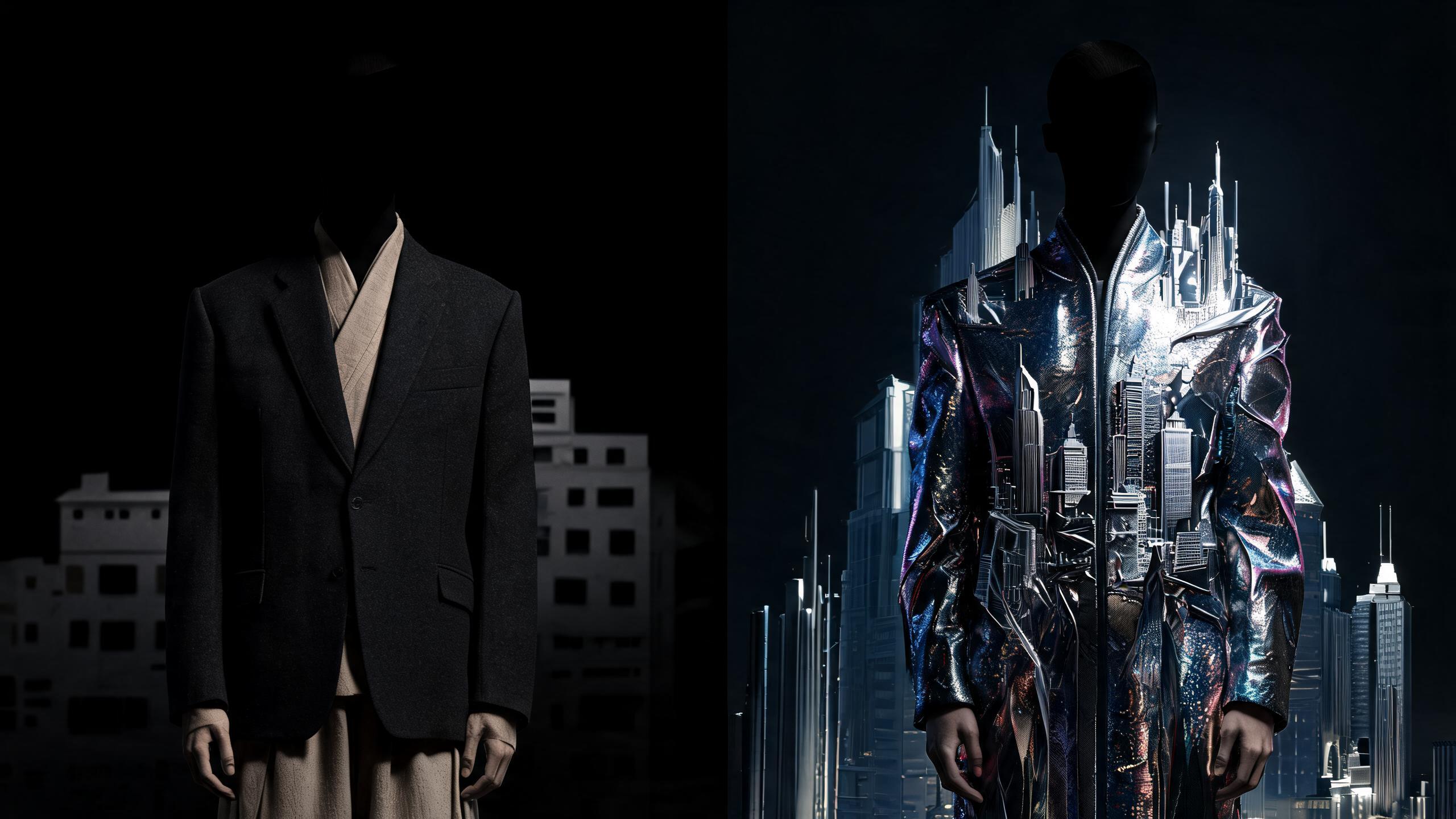
See how Demna AI matches silhouettes, fabrics, and details more precisely than traditional search when sourcing comparable fashion pieces.
Demna AI find similar clothing items is an AI-powered visual-search capability that identifies garments resembling a reference image by analyzing attributes such as silhouette, color, pattern, material, and style. Unlike traditional keyword search, it matches visual features directly and can return visually similar products even when users lack precise descriptive terms.
Demna AI vs Traditional Search for Finding Similar Clothing
Key Takeaway: Demna AI finds similar clothing items by analyzing visual details, garment structure, color, and personal style, while traditional search relies mainly on text, keywords, and product metadata.
Demna AI finds similar clothing by interpreting visual attributes, garment structure, and personal style rather than matching text alone.
Finding a similar clothing item sounds simple until the search begins. A shopper sees a jacket in a photograph, a pair of trousers in a street-style image, or a knit worn by someone on a screen. The desired result is not the exact original item.
It is something with a comparable silhouette, material impression, color relationship, proportion, and styling potential.
Traditional search handles this task through words, filters, product categories, and manually assigned metadata. Demna AI approaches it as a visual and contextual retrieval problem. The distinction matters because clothing is not defined by one label.
A “black jacket” can be cropped, oversized, structured, washed, padded, double-breasted, technical, or softly tailored. Text search often compresses these differences into a shallow category.
The clear recommendation is to use Demna AI for visual discovery and similarity, while retaining traditional search for precise constraints such as brand, size, price, availability, and material. The strongest system combines both approaches. Traditional search supplies control.
AI supplies interpretation.
Demna AI: An AI-powered fashion search approach that analyzes clothing images and style context to identify visually and functionally similar items, then refines results through user preferences and interaction feedback.
What Does “Find Similar Clothing Items” Actually Mean?
“Similar” is not a single property in fashion search. It describes a relationship between garments across several dimensions, and each shopper may assign different importance to those dimensions.
A person searching for a replacement may want the same cut in another color. Another shopper may want a lower-priced alternative with the same visual effect. Someone building an outfit may not want a near-duplicate at all; they may want a compatible piece that preserves the original styling logic.
A useful similarity model separates the task into distinct layers:
- Visual similarity: color, pattern, texture, shape, and visible details.
- Structural similarity: garment category, construction, neckline, sleeve shape, rise, length, and fastening.
- Styling similarity: how the piece works with footwear, layering, accessories, and proportions.
- Functional similarity: warmth, movement, durability, weather resistance, and occasion suitability.
- Commercial similarity: price, availability, size range, delivery region, and condition.
- Preference similarity: alignment with the user’s established taste profile.
Traditional search usually exposes commercial and categorical dimensions. Demna AI is better positioned to interpret visual, structural, and styling dimensions.
This creates an important distinction:
- Exact retrieval asks: “Where is this product?”
- Similar-item discovery asks: “What else produces this visual or functional effect?”
The first is an indexing problem. The second is an interpretation problem.
How Does Traditional Clothing Search Work?
Traditional clothing search depends on a product catalog organized through structured fields. A retailer or marketplace assigns attributes such as category, color, brand, material, fit, gender presentation, season, and price. The search engine then compares the shopper’s query with those fields.
A text query such as “oversized navy wool coat” can work well when the catalog contains accurate attributes and the shopper knows the correct vocabulary. Filters improve precision by narrowing the result set through explicit constraints.
Traditional search typically uses several mechanisms:
- Keyword matching: connects words in the query with product titles and descriptions.
- Faceted filtering: narrows results by fields such as size, color, brand, price, and category.
- Taxonomy matching: maps informal language to catalog categories.
- Popularity ranking: prioritizes items with stronger engagement or sales signals.
- Metadata weighting: ranks products according to relevance, completeness, and commercial availability.
This approach is predictable and inspectable. A shopper can see why a result appeared: it matched “black,” “trousers,” “wide leg,” or a selected brand.
The limitation is that fashion meaning often lives outside product metadata. A product title may say “relaxed-fit cotton overshirt,” while the image communicates a boxy architectural shape, faded surface, dropped shoulder, and short body length. The written description captures category.
It rarely captures the complete visual grammar.
Traditional search also assumes the user can articulate what they see. That assumption fails when the shopper does not know the name of a construction detail or when the garment’s appeal comes from a combination of attributes rather than one searchable term.
Where Traditional Search Performs Best
Traditional search remains strong when the shopper has explicit requirements:
- A specific brand or designer.
- A known product name.
- A defined price ceiling.
- A required size.
- A specific fabric or care requirement.
- A particular delivery region.
- A replacement for an item already identified.
- A narrow category such as “women’s waterproof shell jacket.”
It also performs well when catalog metadata is unusually detailed and consistent. Uniform product photography, standardized attributes, and disciplined taxonomy reduce ambiguity.
Traditional search is not obsolete. It is simply optimized for a different question: retrieve products that satisfy declared constraints.
How Does Demna AI Find Similar Clothing Items?
Demna AI treats an image, product page, or saved item as a source of signals rather than as a single keyword. The system can analyze visible properties and compare them with indexed products through image embeddings, attribute recognition, multimodal retrieval, and preference-aware ranking.
The process can be understood as a sequence:
- Input capture: The user uploads an image, selects a catalog item, or references a product page.
- Garment localization: The system identifies the relevant clothing item within the image.
- Attribute extraction: It detects visual and structural features such as silhouette, color relationships, texture, length, fit, and details.
- Representation: These features are transformed into a searchable vector representation.
- Candidate retrieval: The system searches a catalog for items with comparable representations.
- Contextual ranking: Results are reordered using the user’s style model, constraints, and previous interactions.
- Feedback learning: Saves, dismissals, clicks, and outfit behavior update future recommendations.
The important shift is from query-to-product matching to item-to-item and person-to-item matching.
A visual model does not need the shopper to know whether a top is technically a sweatshirt, knit polo, or brushed jersey pullover. It can retrieve items that share the relevant visual structure even when catalog language differs.
However, AI similarity is not magic. A model can identify that two garments look alike while missing a crucial difference in fabric weight, transparency, stretch, or construction quality. Strong systems therefore combine visual signals with product metadata and user-specific constraints.
What Signals Can AI Interpret?
A fashion-specific model can reason across signals such as:
- Dominant and secondary colors.
- Contrast placement.
- Garment outline and proportions.
- Collar, cuff, pocket, and closure details.
- Sleeve volume and shoulder structure.
- Hem position and garment length.
- Surface texture and visual weight.
- Pattern scale and repetition.
- Layering relationships.
- Footwear and accessory context.
- Occasion cues.
- User-specific tolerance for novelty.
This does not mean every signal is equally reliable. Color is often easier to infer from an image than fiber content. Silhouette is visible, but exact measurements are not.
The system should represent uncertainty internally and allow the shopper to correct important attributes.
For a deeper look at the image-processing layer, How Demna AI Removes Backgrounds from Clothing Photos explains why separating garments from their surroundings improves visual retrieval.
Which Approach Understands Visual Similarity Better?
Demna AI has the advantage when the reference is visual and the desired result is “same feeling” rather than “same words.”
Traditional search depends on the vocabulary used by the shopper or catalog team. If the shopper searches for “short structured black coat,” results may exclude a cropped wool blazer, a boxy technical jacket, or a compact car coat even when those pieces occupy the same visual role.
AI can compare shapes and relationships directly. It can recognize that a cropped, wide-shouldered jacket with a high collar belongs to a similar visual family as another item described with completely different terms.
The difference is especially clear in three situations:
1. The Shopper Has an Image but No Product Name
A screenshot contains visual information but often no searchable text. Reverse image search can locate the exact image or product, but traditional keyword search has little to work with.
Demna AI can isolate the garment and generate a candidate set based on visual attributes. It can search for comparable pieces even when the original item is unavailable.
2. The Shopper Wants an Aesthetic Match
A user may want “a softer version of this jacket” or “the same shape but less formal.” These are relational requests. They require the system to preserve selected properties while changing others.
Traditional filters can approximate the request through multiple manual selections. An AI system can model the request as a transformation:
- Keep the cropped proportion.
- Keep the dark neutral palette.
- Reduce shoulder structure.
- Lower the formality.
- Preserve compatibility with existing trousers.
3. The Product Vocabulary Is Inconsistent
Retailers use different names for similar garments. One catalog calls an item a “shacket,” another calls it an “overshirt,” and a third calls it a “lightweight jacket.” Text search treats terminology as a barrier. Visual retrieval can bridge it.
This does not make AI automatically superior in every result. An image model can overemphasize superficial resemblance, such as color, while underweighting a key construction detail. The best implementation exposes meaningful controls instead of presenting similarity as an unexplained score.
How Do the Two Approaches Compare Across the Search Journey?
The following table summarizes the practical difference between Demna AI and traditional search.
| Feature | Demna AI | Traditional Search |
|---|---|---|
| Primary input | Images, product pages, natural-language intent, interaction history | Keywords, filters, product names, catalog metadata |
| Core strength | Visual and contextual similarity | Precise constraint matching |
| Vocabulary requirement | Low; users can begin with an image | Higher; users need useful search terms |
| Similarity basis | Image features, garment structure, styling context, user preferences | Text relevance, taxonomy, metadata, popularity |
| Best for | “Find something like this” | “Find this type of product under these conditions” |
| Handling unknown garment names | Strong | Weak to moderate |
| Price and size filtering | Requires catalog integration | Native strength |
| Exact brand retrieval | Moderate to strong when metadata is available | Strong |
| Novelty control | Can model familiar versus exploratory results | Usually manual through filters or browsing |
| Explainability | Requires careful interface design | Usually clearer from visible filters and labels |
| Risk | Visual false positives, attribute inference errors, opaque ranking | Vocabulary mismatch, rigid categories, repetitive results |
| Learning over time | Can update a personal style model | Usually limited to clicks, purchases, or generic history |
| Recommended role | Discovery, substitution, outfit-compatible alternatives | Verification, narrowing, transaction constraints |
The comparison reveals that these approaches should not compete for the same function. They solve different parts of the task.
Which Approach Handles Natural-Language Intent Better?
Traditional search has improved at interpreting natural-language queries, but its foundation remains catalog retrieval. It can map “minimal black jacket” to likely product attributes, yet it still needs to translate subjective language into fixed fields.
Demna AI can treat natural language as an instruction over visual and personal dimensions. For example:
“Find something similar to this, but lighter, less oversized, and suitable for office wear.”
That request contains:
- A visual reference.
- A desired similarity relationship.
- A change in weight.
- A change in proportion.
- An occasion constraint.
A strong multimodal system can combine the image with the text and search for products that preserve selected characteristics while adjusting others.
The key technical concept is conditional retrieval. Instead of asking which products are closest to the reference overall, the model asks which products are closest after applying user-defined transformations.
This distinction prevents a common failure mode: returning near-identical products that technically match the image but fail the user’s actual intent.
Natural language also supports correction. If the first results are too formal, too colorful, or too oversized, the shopper can state the problem directly. The system should update the search representation rather than forcing the user to restart with new filters.
👗 Want to see how these styles look on your body type? Try Alvin's Club's AI Stylist → — personalized outfits in seconds.
How Important Is Personalization in Similar-Item Search?
Personalization determines whether similarity means “similar to the image” or “similar to the image and suitable for this person.”
A generic visual model can retrieve an accurate lookalike that conflicts with the user’s preferences. It may recommend cuts the person consistently rejects, colors absent from their wardrobe, or items that fail their usual price and size constraints.
A personal style model adds another layer of ranking. It learns from signals such as:
- Items saved repeatedly.
- Recommendations dismissed quickly.
- Garments worn together.
- Colors purchased but rarely used.
- Silhouettes kept over time.
- Brands associated with positive feedback.
- Changes in climate, routine, or fit preference.
- Repeated requests for lower or higher visual similarity.
The system should distinguish between taste and circumstance. A user can like oversized coats aesthetically while preferring compact jackets for commuting. A recommendation engine that treats every click as a permanent preference will misread the user.
Personalization also needs negative evidence. Dismissals, returns, repeated skips, and ignored recommendations reveal boundaries. Without negative signals, an AI stylist becomes a catalog of things the user once viewed rather than a model of what they actually choose.
This connects to the broader question of whether an AI stylist genuinely learns. Can Demna’s AI Handle Clothing Size Changes? examines why changing body measurements and fit preferences require a dynamic model rather than a static profile.
What Are the Advantages and Disadvantages of Demna AI?
Advantages of Demna AI
1. It starts with how clothing is seen. Users can search from screenshots, outfit photos, saved images, or product photography. This reduces dependence on exact vocabulary.
2. It retrieves across inconsistent naming systems. Visual similarity can connect products described with different retail terms.
3. It supports controlled variation. The user can request the same silhouette in another material, a similar item with less volume, or a comparable alternative at a different price level.
4. It can learn a personal definition of similarity. One shopper may prioritize fabric and construction. Another may prioritize proportion and color.
The model can adapt to those weights.
5. It can connect search with outfit compatibility. The best alternative is not always the closest visual duplicate. It is often the item that works with the user’s existing wardrobe.
6. It reduces repetitive browsing. A well-ranked candidate set can replace dozens of vague searches and manual filter combinations.
Disadvantages of Demna AI
1. Visual resemblance can conceal functional differences. Two shirts may look similar while differing sharply in warmth, stretch, transparency, or durability.
2. Image conditions affect recognition. Lighting, pose, cropping, occlusion, and image quality can distort color and shape interpretation.
3. Ranking can become opaque. If users cannot understand why an item appears, they may struggle to correct the system.
4. Product coverage remains decisive. A sophisticated model cannot retrieve products absent from its index or hidden behind poor catalog data.
5. Personalization can overfit. If the model learns only from past behavior, it may repeatedly recommend safe variations and suppress useful discovery.
6. Privacy requires deliberate architecture. Images of people, bodies, homes, and wardrobes can reveal sensitive information. Collection, retention, deletion, and processing policies must be clear.
The strongest AI search system treats these disadvantages as design requirements, not footnotes.
What Are the Advantages and Disadvantages of Traditional Search?
Advantages of Traditional Search
1. It handles explicit constraints well. Price, size, brand, material, color, condition, and availability are easy to expose as filters.
2. It is comparatively explainable. A product appears because it matches visible terms or selected attributes.
3. It performs well for known-item search. When the shopper knows the brand, model, or product category, text retrieval is efficient.
4. It supports transactional decisions. Retail metadata is essential for stock, shipping, returns, and product specifications.
5. It is easier to audit. Structured fields can be reviewed, corrected, and standardized without retraining a model.
Disadvantages of Traditional Search
1. It forces users to translate visual ideas into language. The system asks the shopper to describe a garment before helping them understand it.
2. It fragments the search process. A shopper must separately filter category, color, fit, material, and price, even when the desired object is a single visual impression.
3. It inherits catalog inconsistency. Different sellers label similar items differently, making cross-catalog discovery unreliable.
4. It favors what is already well-labeled. Unusual or editorial products can disappear if their metadata is sparse.
5. It often confuses popularity with relevance. Popular items are not automatically suitable for a specific user.
6. It has limited memory of taste. A user may repeatedly explain the same preferences because the search system does not maintain a robust personal representation.
Traditional search provides valuable precision, but precision over the wrong interpretation is still failure.
When Should You Use Demna AI Instead of Traditional Search?
Demna AI is the stronger first step when the shopper’s intent is visual, comparative, or exploratory.
Use Demna AI When:
- You have a screenshot or outfit image.
- You do not know the garment’s exact name.
- You want alternatives to an unavailable item.
- You want the same shape in a different color or material.
- You want a similar aesthetic at a different price point.
- You need pieces that fit an existing wardrobe.
- You want recommendations shaped by your past taste.
- You are exploring a style direction without a fixed product category.
Use Traditional Search When:
- You know the exact brand or product.
- You need a specific size immediately.
- You have a strict price limit.
- You require a verified material or technical specification.
- You need delivery or stock information.
- You are replacing an item with precise functional requirements.
- You want to compare sellers, conditions, or return policies.
The most efficient workflow begins with AI discovery and ends with structured verification.
How Should a Combined Search Workflow Operate?
A combined system should not place an AI image search beside a conventional search box as two disconnected tools. It should create a continuous process in which each approach handles the part it understands best.
Step 1: Start With an Image or Reference Item
The shopper uploads an image, selects a catalog product, or describes the desired look. The system identifies the garment and separates it from irrelevant visual context.
Step 2: Generate a Similarity Set
Demna AI returns products grouped by meaningful relationships:
- Closest visual matches.
- Same silhouette, different color.
- Same aesthetic, lower price.
- Same function, different construction.
- Similar piece compatible with the user’s wardrobe.
Grouping is superior to one undifferentiated grid because it exposes the system’s interpretation.
Step 3: Apply Hard Constraints
The user then selects size, price, brand, material, location, condition, and availability. Traditional filters eliminate commercially unusable results.
Step 4: Adjust the Similarity Dial
A useful interface should let the shopper move between:
- Near match: preserve shape, color, and details.
- Style match: preserve overall visual language while allowing variation.
- Wardrobe match: prioritize compatibility with owned pieces.
- Functional match: prioritize weather, movement, durability, or occasion.
Similarity is not one slider in practice, but these modes help users express intent.
Step 5: Show Why Each Result Appeared
A result could be annotated with concise reasons:
- Similar cropped proportion.
- Same washed cotton texture.
- Comparable shoulder volume.
- Lower formality than the reference.
- Compatible with saved wide-leg trousers.
Explainability turns correction into a productive interaction.
Step 6: Learn From the Decision
The system should learn from meaningful actions, not only clicks. Saving, dismissing, purchasing, returning, wearing, and pairing an item provide different signals. A purchase confirms commercial acceptance, but a saved item may represent aspiration rather than immediate intent.
What Should Explainability Look Like in AI Clothing Search?
Explainability does not require exposing model architecture. It requires showing the attributes that shaped a recommendation and giving the user control over them.
A strong result explanation answers three questions:
- What did the system see?
- What did it prioritize?
- What can the user change?
For example:
“Recommended because it shares the cropped length, boxy shoulder line, and matte black finish. It is less structured and works with three items in your saved wardrobe.”
The explanation should separate observed facts from inferred judgments. “Black color” is an observable attribute. “Works with your wardrobe” is a recommendation claim that should be grounded in known items or prior feedback.
Users should also be able to correct the model:
- “The color is wrong.”
- “Ignore the background.”
- “I want a slimmer fit.”
- “Keep the material, change the length.”
- “Do not show synthetic fabrics.”
- “Prioritize items available in my size.”
This is where AI search becomes a learning system rather than a one-time visual novelty.
For an analysis of recognition failures and correction mechanisms, see Demna AI vs Traditional Methods for Fixing Clothing Recognition Errors.
How Do Privacy and Data Practices Affect the Comparison?
Clothing images can contain more than garments. They may reveal a person’s face, body shape, home, location, social relationships, or daily routine. A search system that accepts wardrobe images must treat visual data as sensitive operational input.
Traditional search generally collects typed queries and interaction events. That does not eliminate privacy concerns, but the data is often less visually revealing than a personal image library.
Demna AI requires stronger controls across the entire data lifecycle:
- Collection: Request only the image and metadata necessary for the task.
- Processing: Explain whether analysis occurs on the device, on a server, or through a third-party service.
- Retention: State how long images and derived representations remain available.
- Deletion: Provide a clear way to remove source images and associated records.
- Training use: Distinguish product personalization from model training.
- Access: Restrict internal access to sensitive visual data.
- Derived data: Treat embeddings and inferred attributes as data requiring governance.
Deletion is especially important. Removing an image from a visible interface does not necessarily remove cached copies, embeddings, logs, or downstream derivatives. A trustworthy system must define deletion operationally, not cosmetically.
Privacy is not separate from product quality. Users will not build a detailed personal style model if they do not understand how their wardrobe data is handled.
Which Approach Produces Better Results for Different Use Cases?
No single search method wins every scenario. The correct choice depends on the user’s starting point and the kind of similarity required.
| Use Case | Better First Tool | Why |
|---|---|---|
| Finding the exact item from a known product name | Traditional search | Text and catalog identifiers provide high precision |
| Finding alternatives from a screenshot | Demna AI | The image carries more information than the user’s vocabulary |
| Searching within a strict budget | Traditional search after AI retrieval | Price filtering is a structured catalog task |
| Finding a similar silhouette in another color | Demna AI | The system can preserve shape while modifying color |
| Finding a verified fiber composition | Traditional search | Material claims require product metadata and documentation |
| Building an outfit around an owned garment | Demna AI | Compatibility requires wardrobe and styling context |
| Searching secondhand listings with inconsistent titles | Demna AI | Visual retrieval reduces dependence on seller terminology |
| Finding an item in stock at a specific size | Traditional search | Inventory and size data are hard constraints |
| Exploring a new aesthetic | Demna AI | Discovery benefits from controlled visual variation |
| Replacing a technical garment | Combined approach | AI finds functional analogues; metadata verifies performance |
The most productive search journey is therefore sequential rather than ideological.
How Should Similarity Be Evaluated?
A clothing search engine should not measure success only through clicks. Clicks can reflect curiosity, confusion, or accidental relevance. Evaluation needs to distinguish visual accuracy, usefulness, and eventual adoption.
A rigorous evaluation framework includes:
Visual Relevance
Does the candidate share the reference’s intended attributes? Human evaluators can assess silhouette, color, pattern, texture, and construction.
Intent Relevance
Did the result satisfy the user’s actual request? A result can be visually close but fail if the user asked for a less formal or more durable alternative.
Constraint Satisfaction
Does the item meet size, price, material, location, and availability requirements?
Wardrobe Compatibility
Can the user plausibly wear the item with existing pieces? This requires outfit-level evaluation rather than isolated product judgment.
Diversity
Does the result set include meaningful alternatives, or ten nearly identical products from one catalog cluster?
Calibration
Does the system express confidence appropriately? A low-confidence result should not appear with the same certainty as a strong visual match.
Learning Quality
Do user corrections improve subsequent recommendations? A system that repeats the same error is not learning, regardless of how sophisticated its first result appears.
These dimensions should be evaluated separately because aggregate relevance scores hide the source of failure.
What Failure Modes Should You Expect?
Traditional Search Failure Modes
- Synonym mismatch.
- Incomplete or inaccurate product attributes.
- Excessive dependence on popularity.
- Category boundaries that do not reflect how people dress.
- Search results that satisfy words but not visual intent.
- Filter combinations that eliminate useful alternatives.
Demna AI Failure Modes
- Confusing background colors with garment colors.
- Treating a similar silhouette as equivalent function.
- Missing hidden construction details.
- Overweighting visual appearance while ignoring fabric composition.
- Recommending items outside practical size or availability constraints.
- Repeating safe options because the model interprets familiarity as preference.
- Producing false confidence when the reference image is ambiguous.
The solution is not to hide failure. It is to expose correction pathways and combine complementary evidence.
An AI model should identify the boundary between what it can see and what it must verify. It can estimate visual texture; it should not present that estimate as a certified fiber composition. It can infer apparent fit from an image; it should not replace garment measurements.
What Does the Final Verdict Look Like?
Demna AI is the better approach for finding similar clothing items when the search begins with an image, an aesthetic impression, or an incomplete description. It understands the problem as visual retrieval and can adapt similarity to the shopper’s preferences.
Traditional search remains the better approach for exact constraints and verified commerce details. It is more reliable for brand, size, price, material, stock, shipping, and product identification.
The comparison is not a choice between intelligence and primitive tools. It is a choice between two layers of the same system:
- Demna AI interprets the desired garment relationship.
- Traditional search verifies the commercial and functional conditions.
The recommended architecture is therefore hybrid:
- Begin with visual and contextual AI retrieval.
- Refine through natural-language corrections.
Apply structured catalog constraints. 4. Explain why each result matches. 5. Learn from decisions over time. 6.
Keep privacy and deletion controls explicit.
Traditional search answers, “Which products contain these terms?” Demna AI answers, “Which products resemble what you mean?” Fashion search needs both questions, but discovery should begin with meaning.
How Does AI-Powered Fashion Intelligence Change Similar-Item Search?
AI-powered fashion intelligence treats “demna ai find similar clothing items” as more than a search phrase. It models the reference garment, the user’s evolving taste, the wardrobe context, and the practical constraints that determine whether a recommendation becomes wearable. AlvinsClub uses AI to build your personal style model.
Every outfit recommendation learns from you. Try AlvinsClub →
Summary
- Demna AI finds similar clothing by interpreting visual attributes, garment structure, silhouette, material impression, color relationships, and personal style.
- Traditional search relies on text, filters, categories, and metadata, which can flatten meaningful differences between garments such as cropped, oversized, structured, padded, or technical designs.
- The keyword demna ai find similar clothing items describes a visual and contextual retrieval approach rather than a simple text-matching process.
- Demna AI is best for visual discovery and similarity, while traditional search remains more effective for precise constraints including brand, size, price, availability, and material.
- The strongest clothing-search experience combines Demna AI’s interpretation with traditional search’s control and filtering capabilities.
Key Takeaways
- Key Takeaway:
- Demna AI for visual discovery and similarity
- Demna AI:
- Visual similarity:
- Structural similarity:
Frequently Asked Questions
What is Demna AI for finding similar clothing items?
Demna AI finds similar clothing items by analyzing visual details such as silhouette, fabric, color, garment structure, and overall style. Unlike traditional search, it can interpret an image even when you do not know the brand or exact product name.
How does Demna AI find similar clothing items?
Demna AI compares the visual attributes of clothing in an image with products that share similar design features and styling. This helps shoppers discover alternatives based on appearance rather than relying only on text descriptions or keywords.
Is it worth using Demna AI instead of traditional search for clothing?
Demna AI is worth using when you have an image but lack the right words to describe the clothing. Traditional search can work well for known brands and product names, while Demna AI is more useful for finding visually similar alternatives.
Can you use Demna AI to find similar clothing items from a photo?
You can use Demna AI to find similar clothing items from a photo, screenshot, or fashion image. The tool examines visible features such as shape, texture, color, and styling to generate relevant clothing matches.
Why does Demna AI find better clothing matches than traditional search?
Demna AI can find better clothing matches because it evaluates visual relationships instead of matching text alone. This allows it to recognize similarities in proportions, materials, construction, and personal style that standard keyword search may overlook.
Related on Alvin's Club
- See outfits tailored to your body type
- Meet the AI stylist that learns your taste
- Get AI-picked outfits for every occasion
About the author
Building the AI fashion agent at Alvin's Club — personal style models, dynamic taste profiles, and private AI stylists. Writing about where AI meets fashion commerce.
Credentials
- Founder at Alvin's Club (Echooo E-Commerce Canada Ltd.)
- Writes weekly on AI × fashion at blog.alvinsclub.ai
X / @alvinsclub · LinkedIn · alvinsclub.ai
This article is part of Alvin's Club's AI Fashion Intelligence series — the AI fashion agent that influences demand before shopping happens.
Related Articles
- Demna AI vs Traditional Methods for Fixing Clothing Recognition Errors
- Sustainable Clothing Recommendations: Human Stylists vs Demna AI
- Can Demna’s AI Handle Clothing Size Changes?
- How Demna AI Removes Backgrounds from Clothing Photos
- Demna AI’s Image Deletions Reveal Fashion Tech’s Privacy Shift
- How Demna Uses AI to Turn Fashion Sketches Into Clothing
- Inside Demna’s Experiment With AI-Powered Clothing Design
- Demna AI Prompt Examples for Creating Distinctive Clothing
- Demna AI vs Pinterest: Which Connects Your Closet Better?
- Demna AI Outfit Recommendations for Effortless Travel Style
- How to Compare Outfits Side by Side in Demna AI
- How to Use Demna AI for Celebrity-Inspired Outfit Ideas
About the author
- Founder building AI-native fashion commerce infrastructure. I design autonomous systems, agent workflows, and automation frameworks that replace manual retail operations. Currently focused on AI-driven commerce infrastructure, multi-agent systems, and scalable automation.
Comments
Join the discussionNo comments yet. Be the first to comment.