Make your UGC style video for TikTok: shoot vertically, feature a person, introduce the proposition immediately, demonstrate relevant benefits, and end with one clear action. Keep it natural, but verify every product detail and claim before publishing.
What should you prepare before filming?
Start with one audience problem, one product proposition, and one desired action. Prepare:
- Audience: Who has the problem?
- Problem or desire: What recognizable situation opens the story?
- Product proposition: Why is this product relevant?
- Proof: What can viewers see demonstrated?
- Call to action: What should they do next?
- Accurate source material: Confirm the variant, color, dimensions, materials, price, offer, and availability.
- Creator permission: Agree on content and likeness usage, including paid advertising if applicable.
- Destination: Ensure the product page matches the item and offer.
A UGC treatment does not make unsupported claims acceptable. Separate visible facts—such as adjustable straps—from conclusions needing evidence, such as suitability for every body type.
What production specification should you use?
TikTok’s creative best practices for performance ads recommend making creative for TikTok rather than repurposing a horizontal commercial.
| Element | Starting specification | Limitation |
|---|---|---|
| Frame | Vertical 9:16 | Reframe footage rather than adding large empty borders |
| Resolution | At least 720p | Cannot repair blurred or poorly lit footage |
| Audio | Use sound, speech, or music | Confirm usage rights |
| Composition | Keep content within the interface safe zone | Preview placement because interface elements can cover content |
| Presenter | Use a creator, employee, or customer where appropriate | Do not manufacture a customer experience |
| Visual style | DIY or not overly polished | Natural must not mean inaudible, misleading, or careless |
| Opening | Introduce the proposition within three seconds | Do not delay the product |
| Hook | Prioritize it within six seconds | It must lead honestly into the product |
| Body | Show relevant selling points | Choose points you can explain clearly |
| Text | Add captions or concise overlays | Keep words legible and within the safe zone |
| Ending | Give a clear call to action | Match one action to the destination |
These are starting practices, not sales guarantees. TikTok describes them as general guidance and advises advertisers to keep testing and learning.
How should you structure the script?
Use hook, demonstration, proof, and action.
1. Open with the situation
Tell the intended shopper why the video matters:
- “If dining chairs leave your back aching…”
- “Here’s an easy way to dress up without wearing a full-length gown.”
- “This cat tree fits vertically instead of taking over the room.”
Avoid unrelated suspense. The opening should connect directly to the product proposition.
2. Introduce the product immediately
Show or name the item while presenting the problem. Avoid a logo animation, broad lifestyle montage, or generic greeting. Viewers should quickly understand what the product is, who it may suit, why it is shown, and what the video will demonstrate.
3. Demonstrate one or two selling points
Show benefits visibly: how a garment moves, where a chair adjusts, or how much floor area furniture occupies.
Appearance alone cannot prove long-term durability, precise measurements, medical benefits, or universal comfort.
4. Add a direct CTA
Use one instruction:
- “See the available colors.”
- “Check the size guide.”
- “View the product details.”
- “Shop this style.”
Match the action to the landing page. If the video says “choose your color,” the destination should show the correct product and available options.
How do you make it look native without making it careless?
Use natural speech, direct-to-camera delivery, practical surroundings, and product-centered demonstrations. Resemble a useful TikTok post without disguising an advertisement or fabricating an independent opinion.
- Film at eye level or from a natural handheld angle.
- Use bright, even light.
- Speak in short sentences.
- Cut pauses while retaining a believable rhythm.
- Let the creator handle or wear the product where appropriate.
- Use accurate close-ups.
- Keep captions away from interface edges.
- Ensure music does not obscure speech.
Script essential claims and the CTA, while allowing the speaker’s normal wording and cadence.
How should product details be preserved?
Use the exact product and variant intended for the ad, then compare the completed video with the listing. Check frame by frame:
- Color and finish
- Shape and proportions
- Prints, patterns, and stitching
- Logos and lettering
- Included parts
- Controls, openings, fasteners, and adjustment points
- Garment length and silhouette
- Product scale
- Spoken and on-screen claims
AI-generated or altered content may change visual details. Do not publish a version that materially changes the item. Source images from multiple angles can help reviewers, but do not guarantee fidelity.
The asset should supplement—not replace—accurate listing photos, dimensions, materials, care instructions, and variant information.
What does a complete example look like?
Hypothetical example: Brown lace midi dress
Audience: A shopper seeking a dressed-up dress without floor length.
Opening, 0–3 seconds:
The creator wears the dress: “Want an occasion dress without the full-length hem?”
Demonstration, 3–8 seconds:
The creator turns: “This brown lace midi gives you a defined shape and an easy midi length.”
Detail, 8–12 seconds:
A closer shot shows the lace and neckline. On-screen text includes only listing-confirmed details.
CTA, final seconds:
“Check the size guide and see the dress details.”
This introduces the proposition, shows visible details, and provides a destination-appropriate action without unverified promises about fit, comfort, quality, or universal suitability.
What can you learn from an actual input-and-output pair?
This curated public pair is not evidence that every generated video will preserve every product equally well.
Case: Jeneva Lace Midi Dress — Brown
Original product input
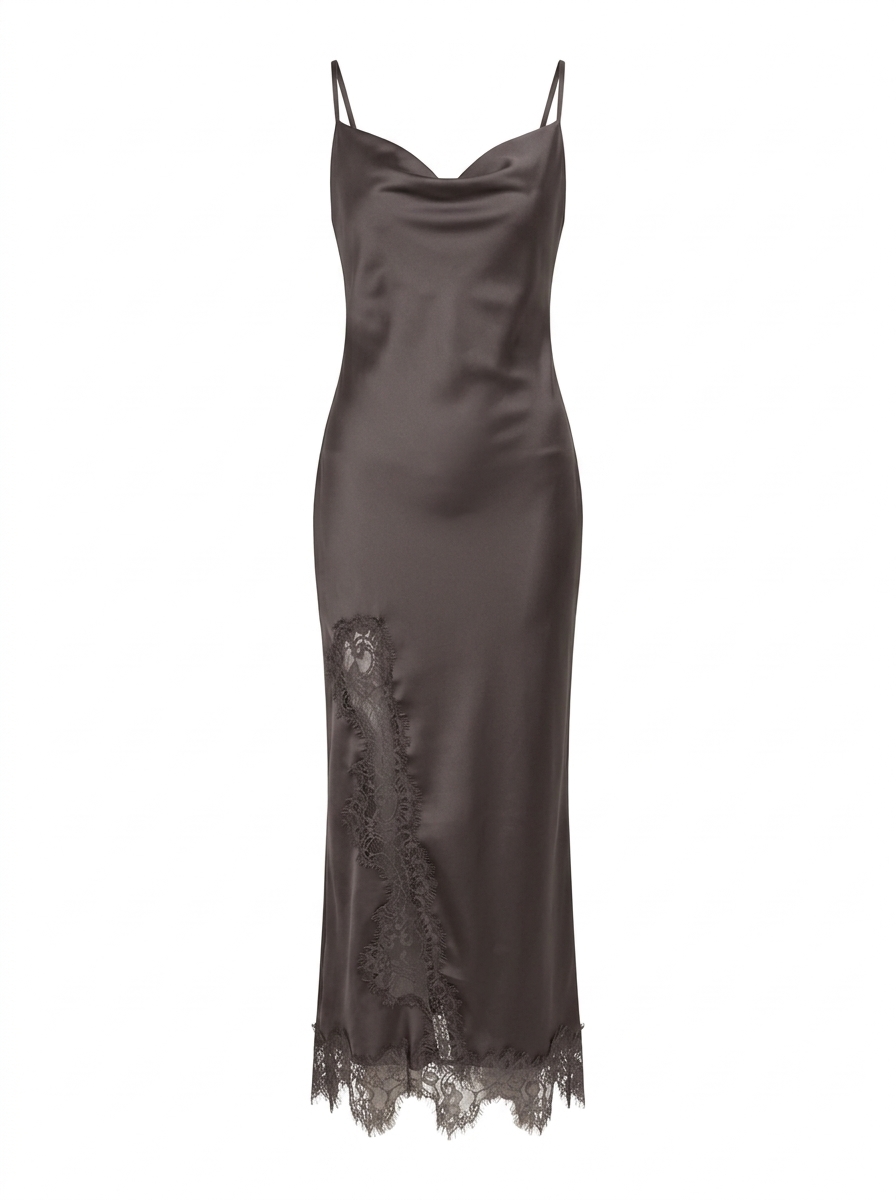
Caption: Original product image supplied as the visual reference.
Completed output thumbnail
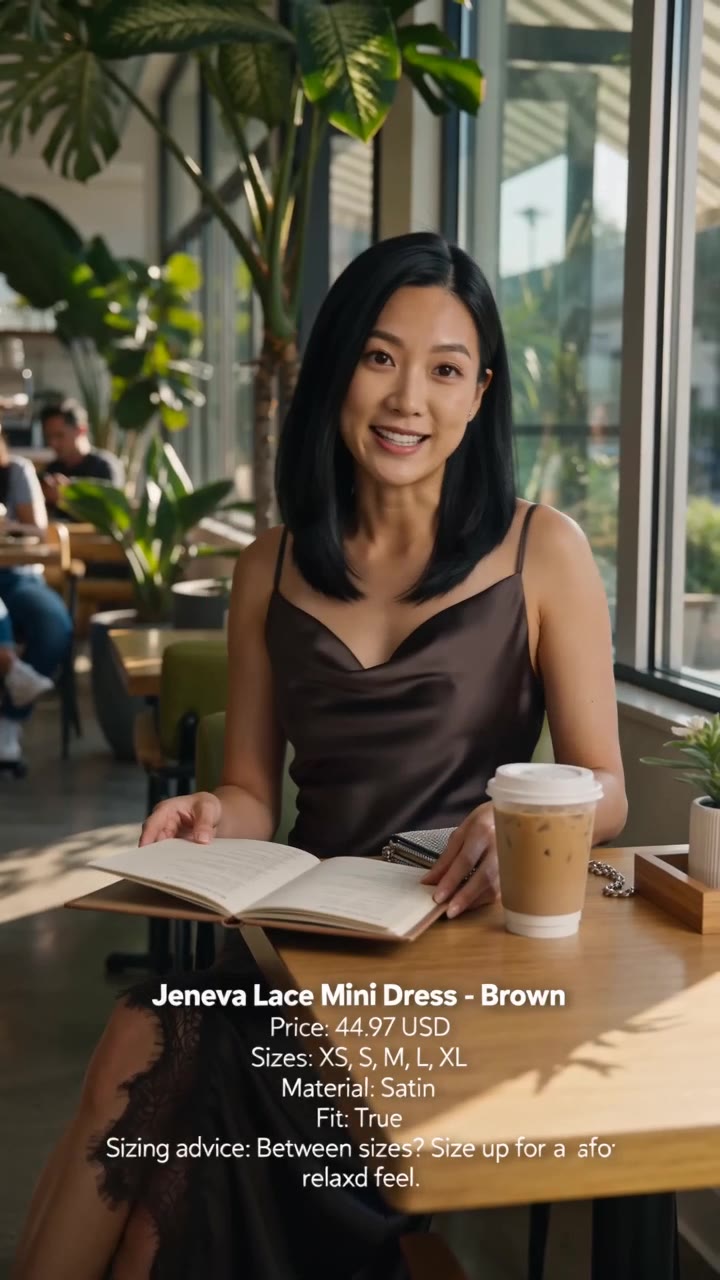
Caption: Thumbnail from the completed output. Watch the video.
Compare the brown color, lace placement, neckline, sleeves, hem, and silhouette. The pair shows a static product image becoming a person-led vertical presentation; it does not establish universal visual fidelity or prove fit, comfort, or conversion performance.
Assign a named human reviewer—for example, “Maya Chen, Ecommerce Manager”—before publication. Use the reviewer’s real name and role; do not copy this hypothetical name unless accurate.
Why does a UGC ad still look like a polished commercial?
Common causes include:
- A long brand introduction
- Unnatural formal copy
- Excessive studio lighting or staged movement
- Broad claims instead of demonstration
- Too many competing graphics
- A generic CTA disconnected from the product page
Correct the largest issue first. Replacing a two-second logo sequence with the product problem will materially change the opening; a casual filter will not.
Why is the video hard to understand?
The proposition, audio, captions, or edit order may be unclear. Viewers should understand “What is this, and why should I care?” within the opening seconds.
- Move the clearest product shot to the beginning.
- Replace the greeting with the audience problem.
- Remove secondary features.
- Shorten the voiceover.
- Add concise captions.
- Make the CTA specific to the next page.
Reposition obscured captions or buttons within the safe zone and preview the intended interface.
What should you test?
Compare materially different concepts:
- Version A: Problem-first direct-to-camera hook
- Version B: Product demonstration in the opening frame
- Version C: Outcome-first hook followed by demonstration
TikTok recommends varied creative and says larger differences are especially useful when testing. Keep the product, offer, destination, and audience reasonably consistent when comparing angles. Do not declare a winner from views alone if purchases are the objective.
When do you need Spark Ads authorization?
You need authorization to use an eligible organic TikTok post from a creator or another authorized identity as a Spark Ad.
TikTok’s Spark Ads creation guide says advertisers can use a linked TikTok account, obtain a creator’s video authorization code, or push a new post to an identity authorized through TikTok Business Center.
Confirm the caption before authorization because it cannot be edited afterward. A private video becomes public when used in a campaign and cannot have its privacy status changed during promotion.
This is separate from filming. A completed file does not automatically provide permission to advertise from a creator’s identity.
When does this advice not apply?
This framework does not replace category-specific rules, substantiation, or documentation. It may not fit:
- Products requiring detailed technical explanation
- Demonstrations that cannot be shown safely
- Claims requiring testing or formal evidence
- Cinematic premium brand campaigns
- Placements with different aspect ratios or interface requirements
- Products whose important details cannot be represented accurately
Retain TikTok-native fundamentals where appropriate, but prioritize accuracy, safety, and responsible-purchase information.
FAQ
Does a UGC style video have to feature a real customer?
No. TikTok suggests creators, employees, or customers. Identify the person’s role honestly and do not script an unexperienced personal testimonial.
Should the video be intentionally low quality?
No. Keep it natural while maintaining clear audio, adequate lighting, legible text, accurate presentation, and at least 720p resolution.
How quickly should the product appear?
Introduce the proposition within three seconds and prioritize the hook within six. Showing the product in the opening frame is often clearest.
Do captions matter with voiceover?
Yes. TikTok recommends captions or text overlays for context. Keep them concise, readable, and clear of interface elements.
Can one creative work for every campaign?
No. TikTok recommends ongoing testing. Product appeal, audience, offer, landing page, delivery, and objective can affect results.
Does a UGC look guarantee sales?
No. Evaluate the full path from creative and targeting to product page, price, stock, and checkout.
Can an AI-generated person act as a customer?
No. Do not present an AI person as a real customer with personal experience. Demonstrate the product accurately and review altered details before publication.
Merchants creating and reviewing short product-video assets can also explore Alvin's Club Studio.
About the author
- Founder building AI-native fashion commerce infrastructure. I design autonomous systems, agent workflows, and automation frameworks that replace manual retail operations. Currently focused on AI-driven commerce infrastructure, multi-agent systems, and scalable automation.
Comments
Join the discussionNo comments yet. Be the first to comment.